News
Latest Updates
Follow our progress, new features, and research insights.
2025 done on the weekends, next to full-time job
1 Nov 2025
HTTPS access
Tree of Knowledge is now fully accessible via HTTPS.
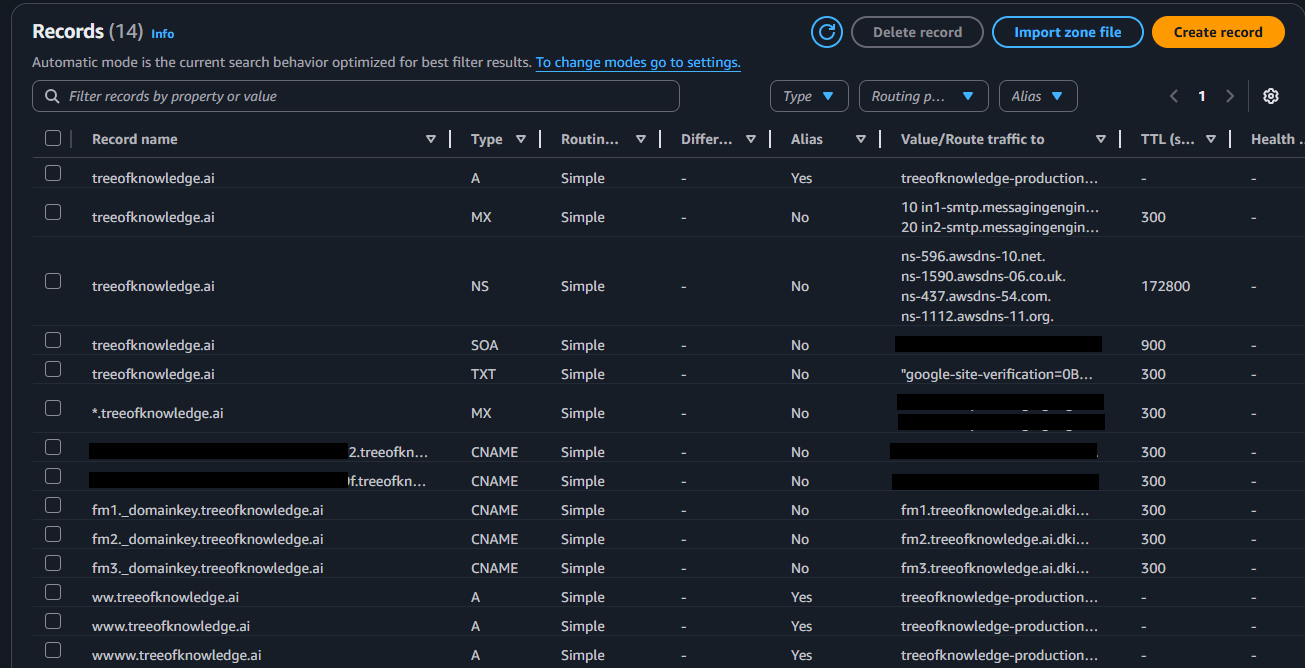
Enabled all pages to be accessed with https (previously only http was possible) through SSL encryption with registered certificate
28 Oct 2025
New video: “Solving Statistics’ Biggest Problems”
A short introduction to the biggest problems in current statistics and how Tree of Knowledge addresses them.
This is somewhat of a teaser-video, serving as first introduction to Tree of Knowledge platform. It explains the biggest problems facing current statistics, says that Tree of Knowledge can solve these problems and redirects to some other videos for the detailled explanation of how exactly these problems are solved
30 Aug 2025
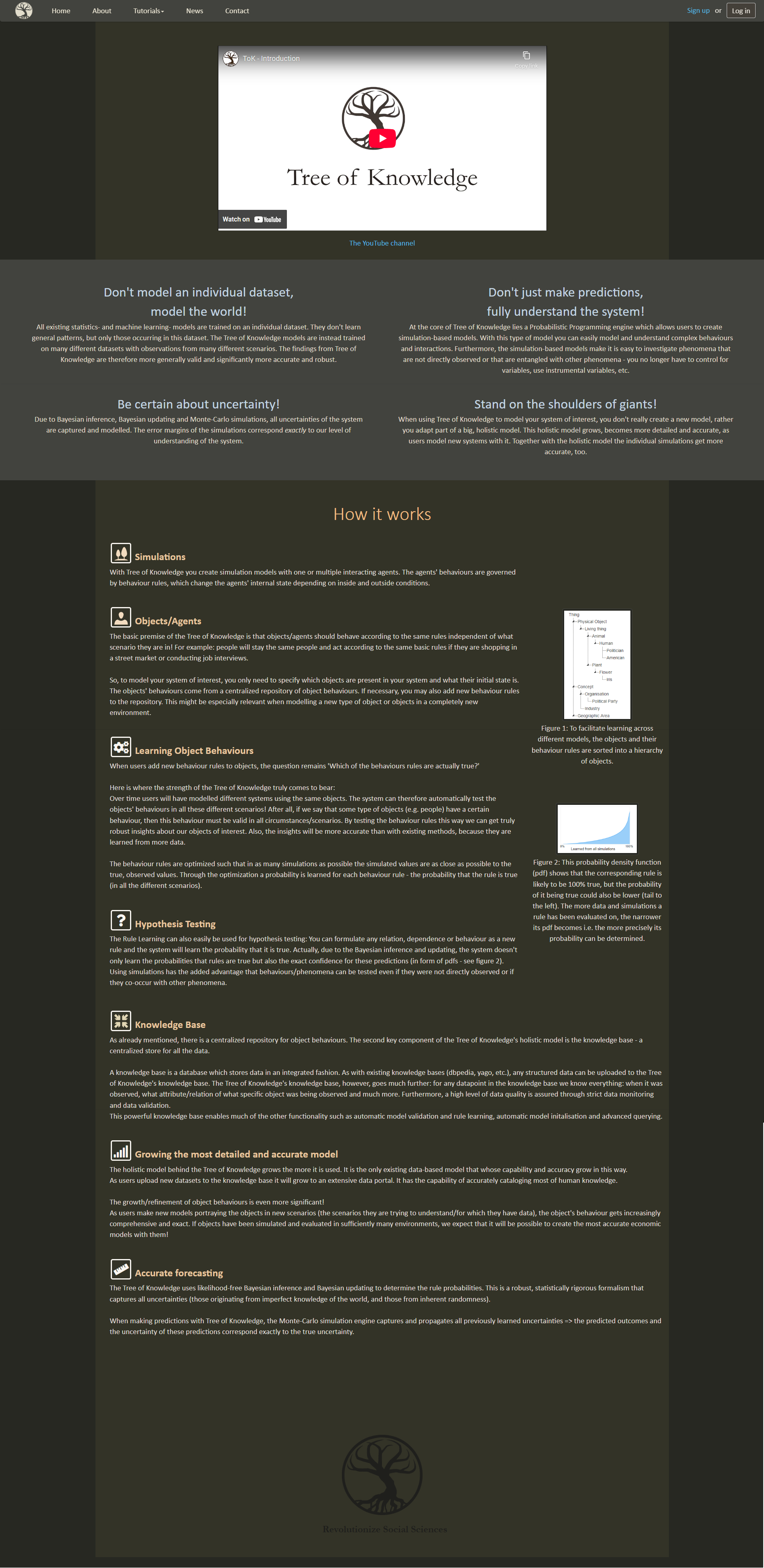
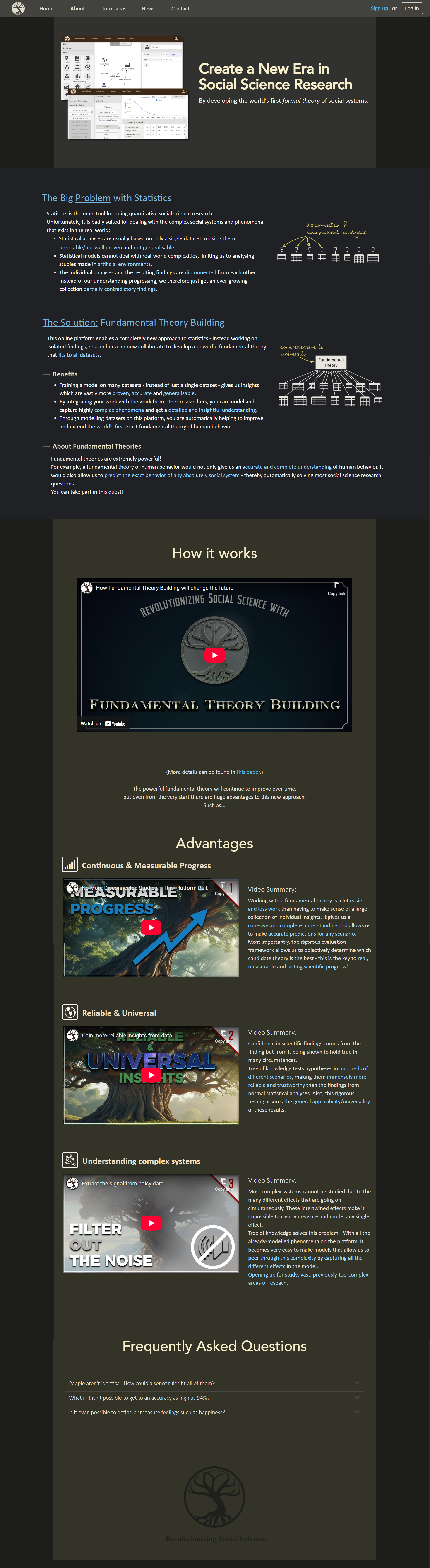
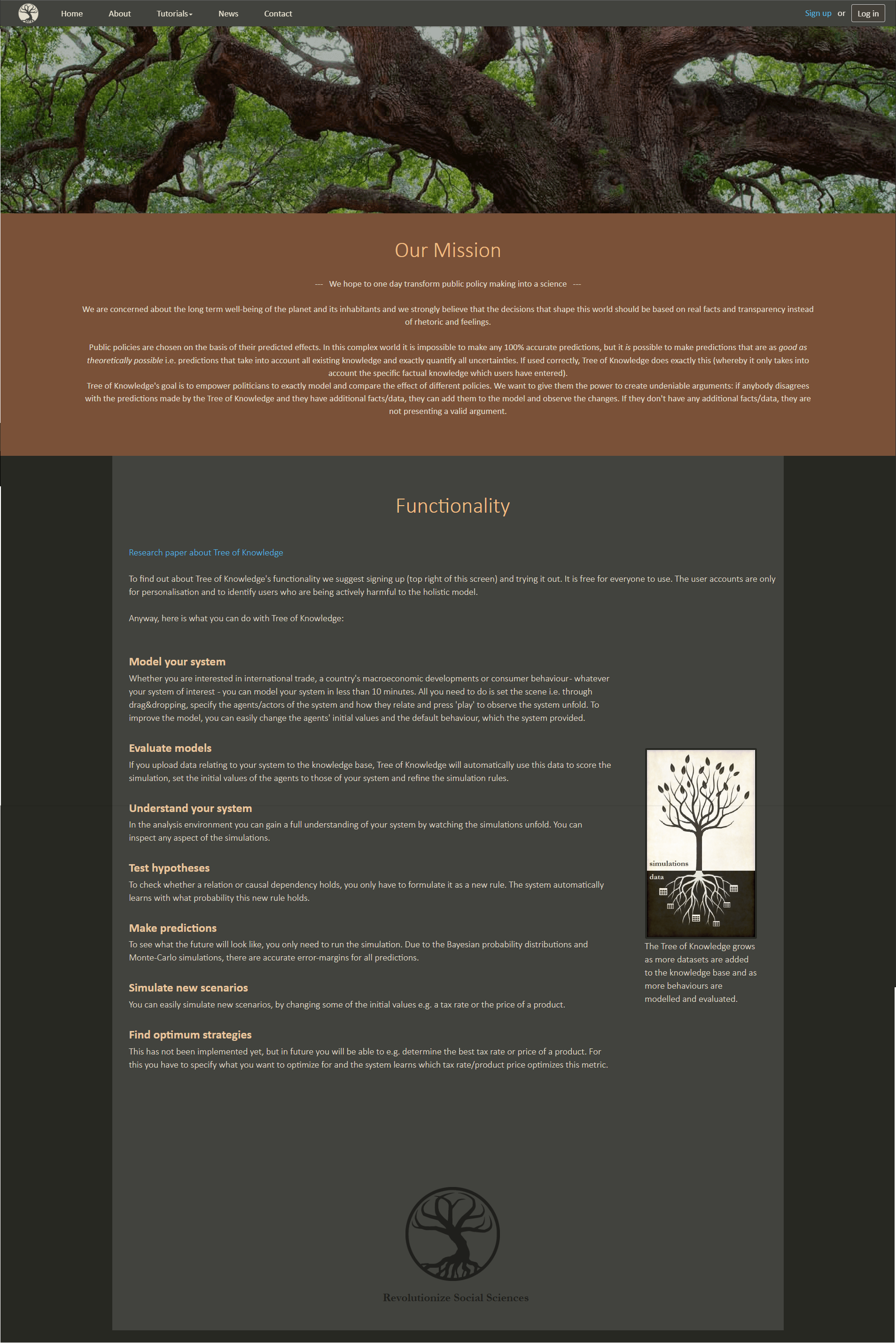
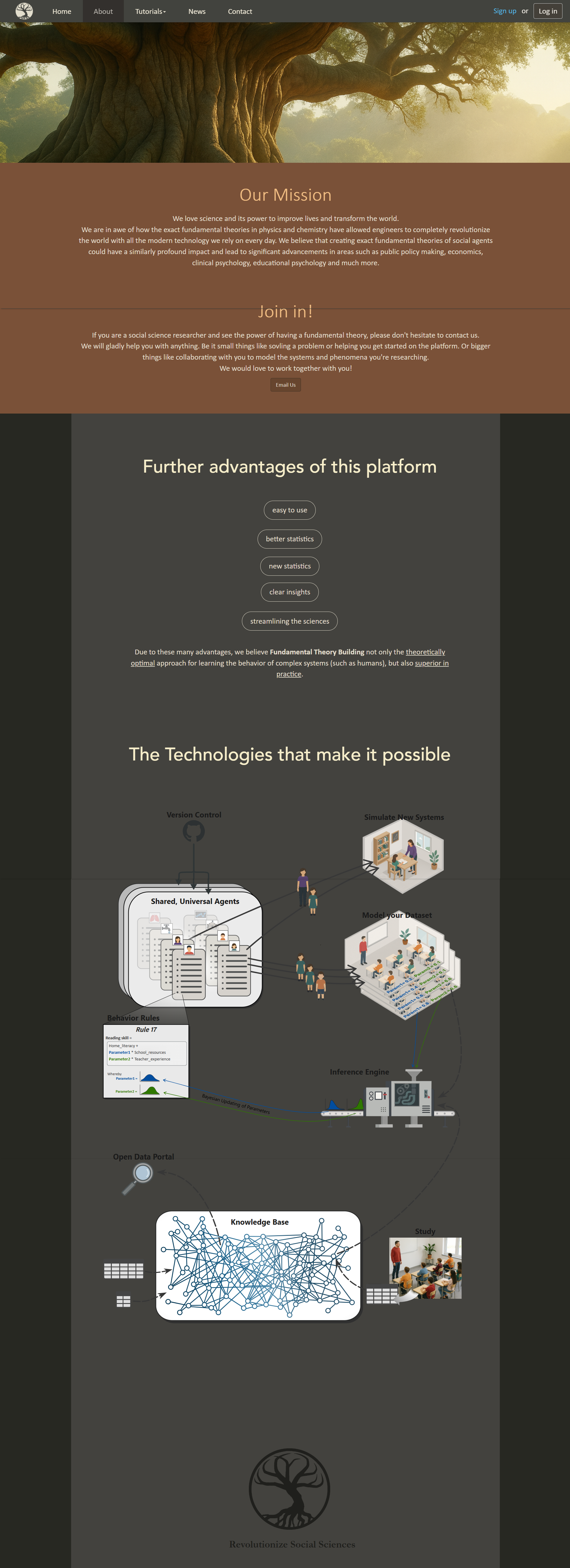
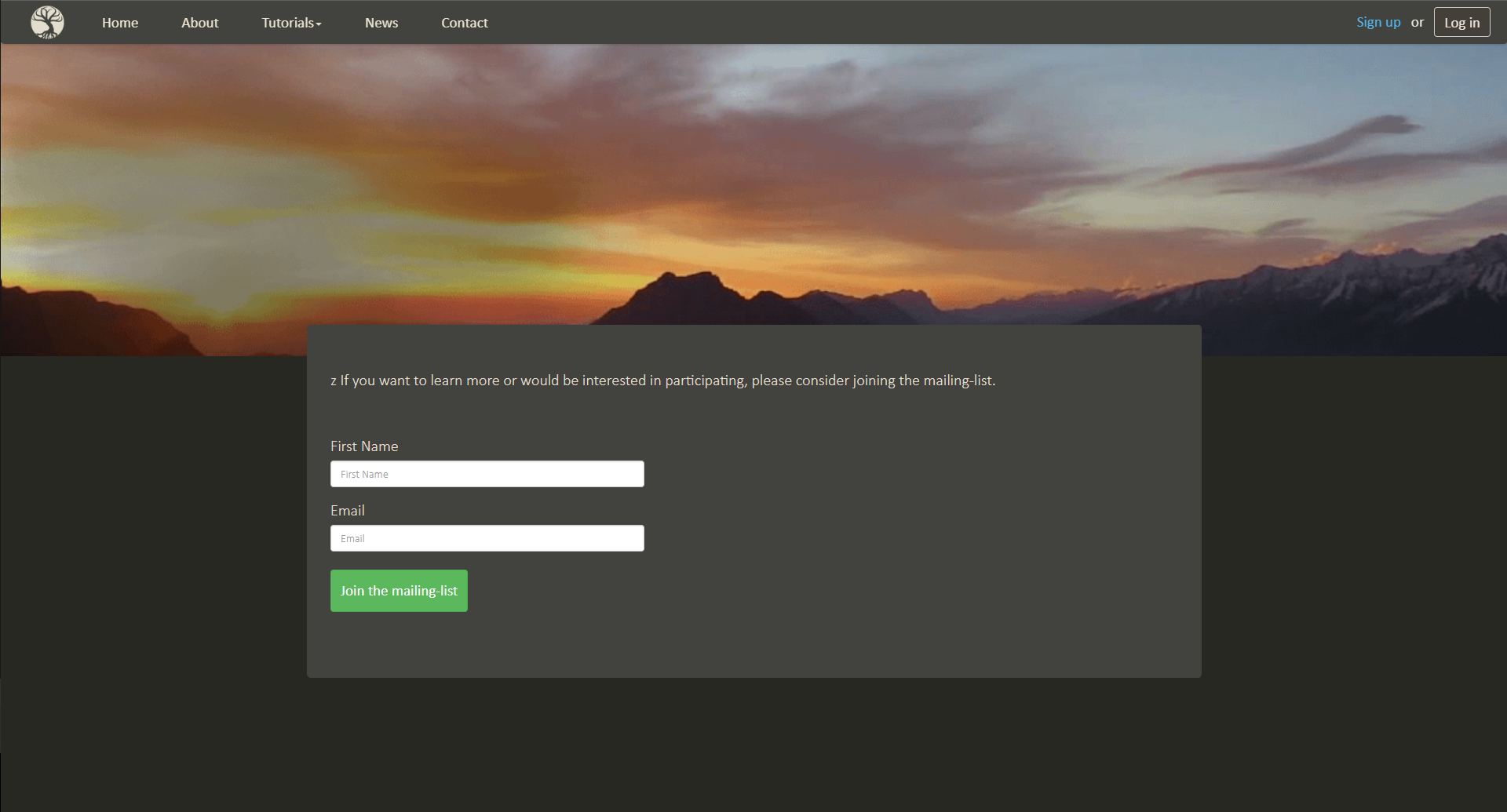
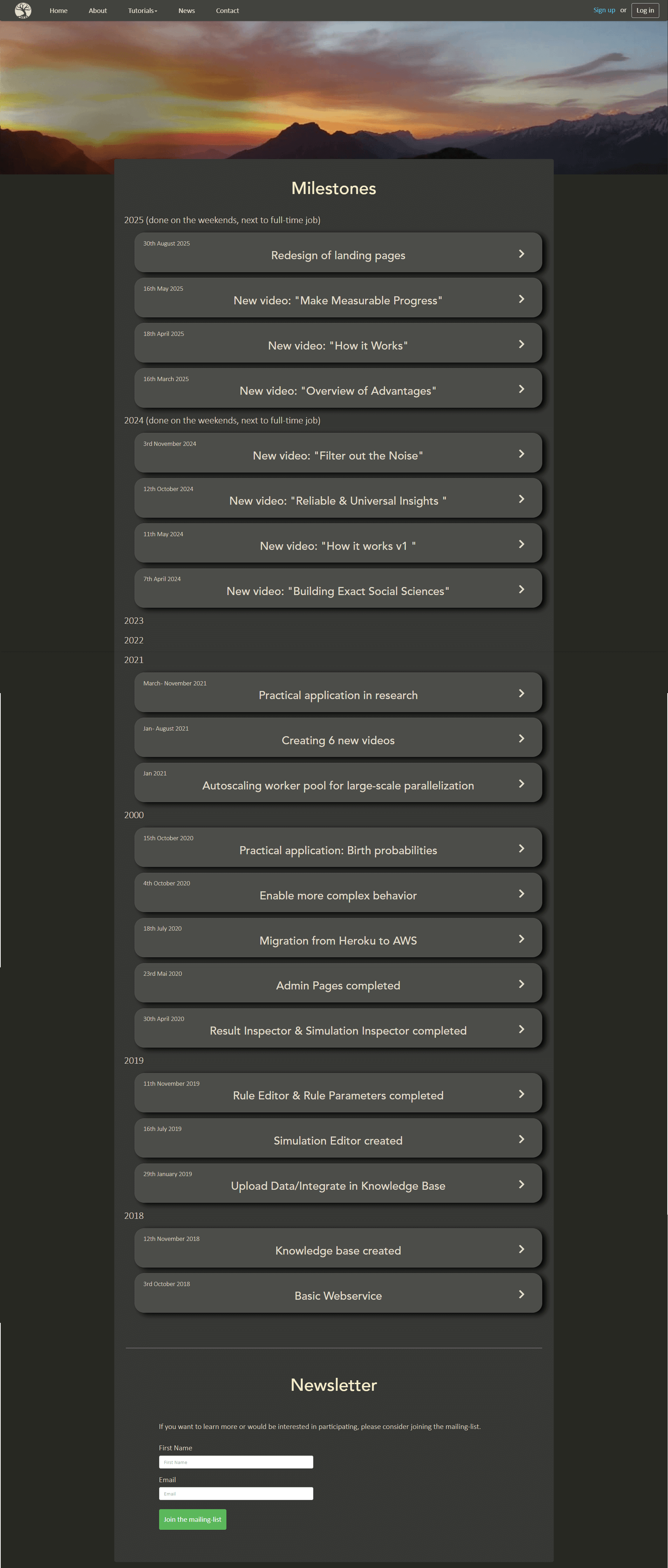
Redesign of landing pages
The Home, About and News pages were redesigned to better explain the platform.
In order to better explain Fundamental Theory building and how this platform works the Home-, About- and News- pages were redesigned:

16 May 2025
New video: “Make Measurable Progress”
How Fundamental Theory Building lets researchers work on a shared, cumulative theory.
This new video shows how Fundamental Theory Building allows the social sciences to move away
from making individual, disjoint ad-hoc investigations of specific phenomena and towards collaboratively working on a powerful, shared fundamental theory.
18 Apr 2025
New video: “How it Works”
A general introduction to the core concepts and ideas behind Tree of Knowledge.
This new video gives a general introduction to Tree of Knowledge and explains all the basic concepts and ideas that make this technology work
16 Mar 2025
New video: “Overview of Advantages”
The 10 biggest advantages of fundamental theories over conventional statistical models.
This video compares the fundamental theories that are created in Tree of Knowledge to conventional statistical models and explains the 10 biggest advantages of fundamental theories
2024 done on the weekends, next to full-time job
3 Nov 2024
New video: “Filter out the Noise”
How Tree of Knowledge extracts reliable insights when phenomena can't be isolated.
In this video the biggest obstacle to studying complex systems is explained: not being able to isolate phenomena and the resulting noise. The video also shows how Tree of Knowledge can help deal with this obstacle and thereby open up many areas of research that have sofar been too complex to study
12 Oct 2024
New video: “Reliable & Universal Insights “
Why fundamental theories are more reliable than conventional statistical findings.
This video shows what a game changer Fundamental Theory Building is: where conventional statistics leads to very unreliable findings (see replication crisis), fundamental theories are highly reliable, rigorously proven and universal
11 May 2024
New video: “How it works v1 “
The first version of the "How it Works" video.
This video is the predecessor of the "How it works" video published on 18th April 2025. It's not quite as good as misses a good Intro.
Creating this video involved learning to use the softwares: Inkscape (for vectorgraphics) and Sozi (vectorgraphic animation).
Creating this video involved learning to use the softwares: Inkscape (for vectorgraphics) and Sozi (vectorgraphic animation).
7 Apr 2024
New video: “Building Exact Social Sciences”
What makes the hard sciences exact, and how the social sciences can get there.
This video looks at what is special about exact/hard sciences and shows how the Fundamental Theory Building approach is able to produce exact Social Sciences.
Creating this video involved learning to use the softwares: Blender, Elevenlabs and VideoPad Editor.
Creating this video involved learning to use the softwares: Blender, Elevenlabs and VideoPad Editor.
2023
28 Nov 2023
Migrating to Python 3
The platform was migrated from Python 2.7 after AWS ended support for it.
The platform had been developed in the years 2018 to 2021 in Python 2.7 - the version I was most familiar with at the time. This locked me into a set of python libraries and library versions that all depended on Python 2.7.
Starting in 2023 AWS however stopped supporting Python 2.7 and effectively shut down the platform.
I had to migrate everything to Python 3, which included finding a new set of mutually-compatible libraries and rewriting large amounts of code.
Starting in 2023 AWS however stopped supporting Python 2.7 and effectively shut down the platform.
I had to migrate everything to Python 3, which included finding a new set of mutually-compatible libraries and rewriting large amounts of code.
2022
2021
Mar–Nov 2021
Practical application in research
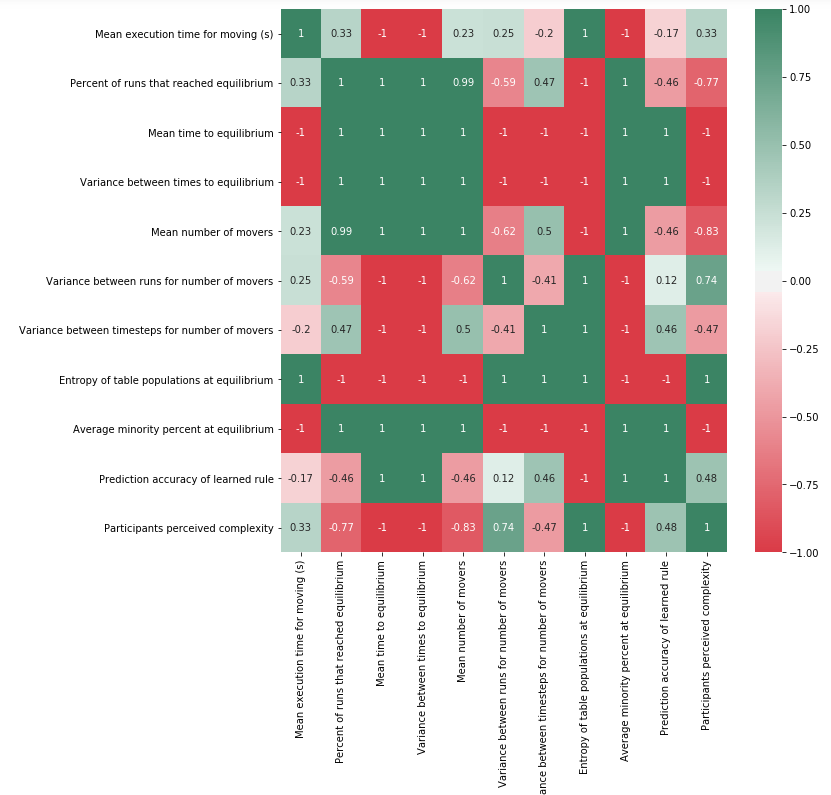
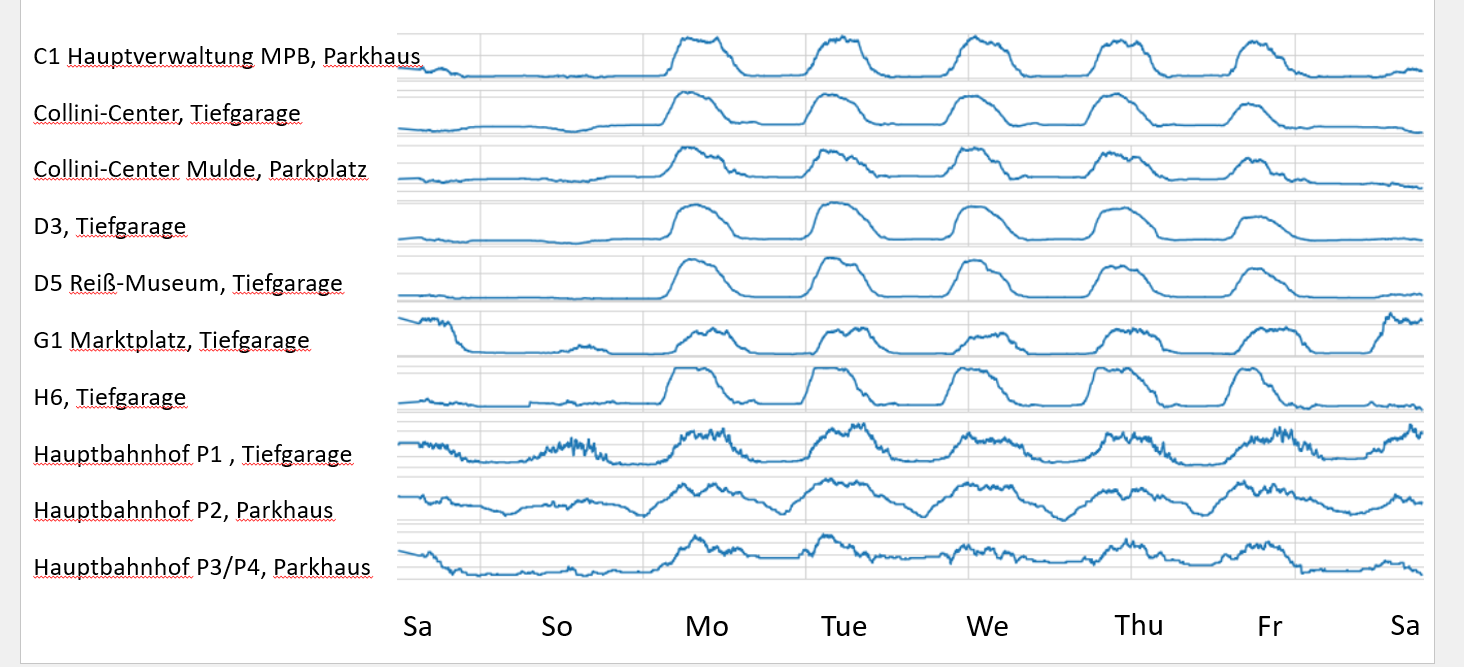
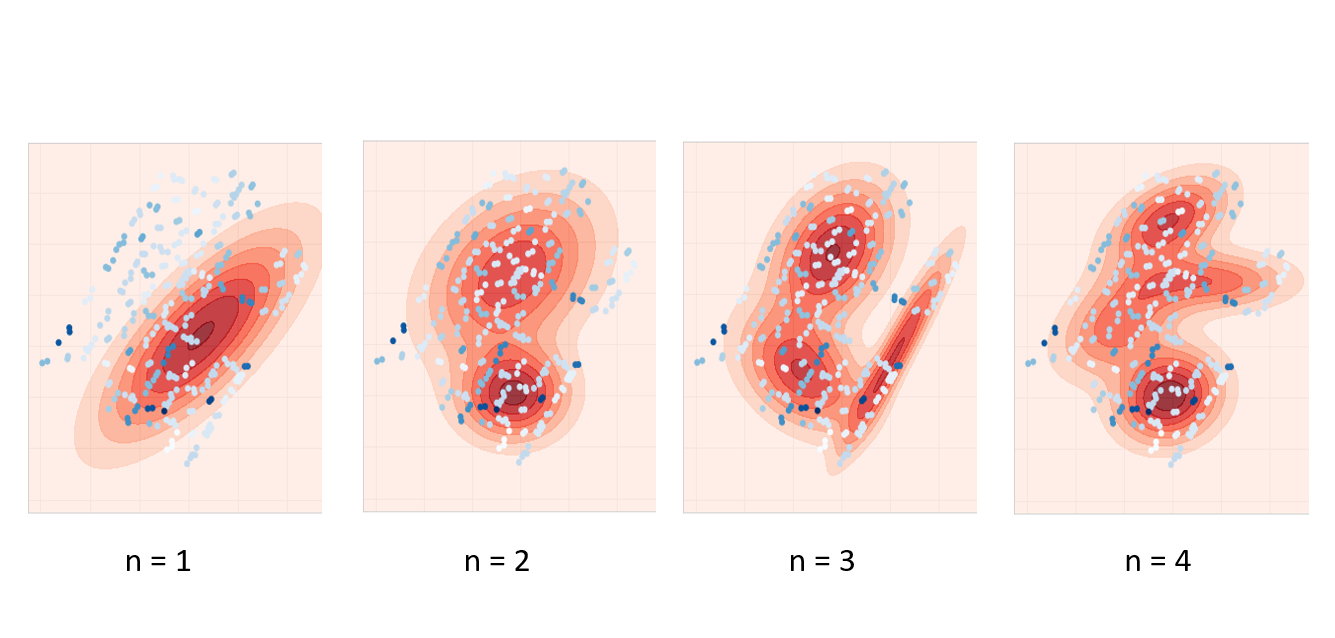
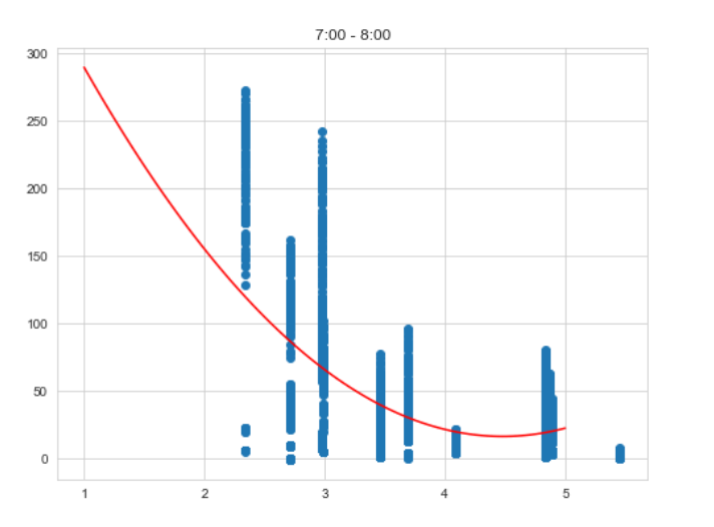
Tree of Knowledge was used in two research projects: task satisfaction and traffic simulation.
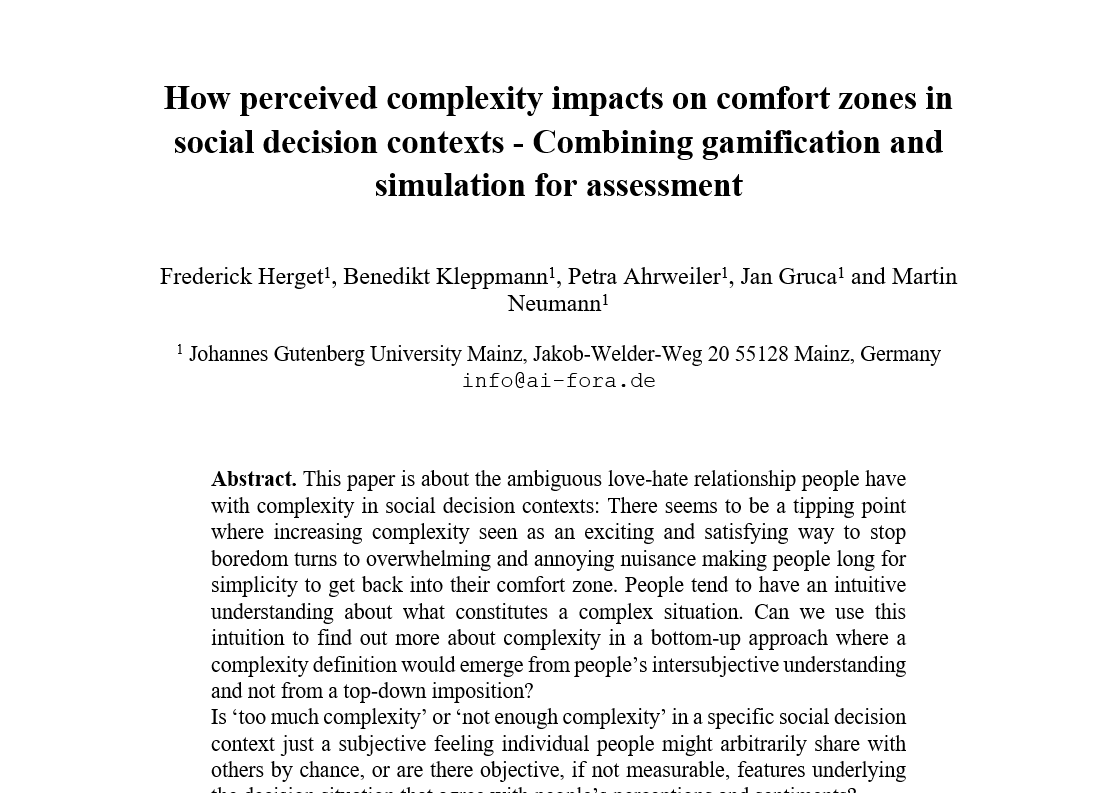
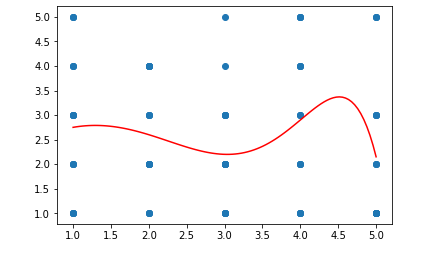
The software Tree of Knowledge was used in two different research projects:
- A project involving modelling people's satisfaction in doing tasks of varying complexity, resulting in this paper
- This other project focussed on traffic simulation
Jan–Aug 2021
Creating 6 new videos
Six videos, each explaining a different aspect of Fundamental Theory Building.
In order to explain the novel Fundamental Theory Building approach and it's overwhelming advantages, six different videos were created, each highlighting a different aspect of this approach.
These are:
"Inspired by human understanding"
This video shows how Tree of Knowledge mimicks the way we humans create models of how the complex and hidden inner mechanisms of people work. It compiles and reconciles many different experiences in the same way.2-minute-long introduction video
"Advantages for Data Scientists"
This video looks at all kinds of models that are available to data scientists, specifically those focused at gaining an understanding of the underlying system."Advantages for Psychologists"
This video focuses on the advantages for Psychologists such as:
- getting robust & generalisable results by combining many studies
- being able to use observational datasets
- having your findings be used in many fields
"Advantages for Sociologists"
This video highlights the advantages of doing Approximate Bayesian Computation for agent-based models and the immense value if you reuse the same agents in many models."Overview"
This video provides an overview of how tree of knowledge works. The different functionalitites are explained, using the example of determining the probability of a women to birth a child in any given year.Jan 2021
Autoscaling worker pool for large-scale parallelization
Simulations now run in parallel on an autoscaling pool of workers.
For doing Bayesian Inference, Tree of Knowledge has to run simulations over and over again with different parameter values. For large simulations and simulations with many unknown parameters, this can take quite some time.
To speed up this process, I implemented an architecture where the Tree of Knowledge backend puts simulation tasks on a celery queue and there is a pool of workers (servers) that take tasks from the queue and run the simulations - see diagram below.
If the simulation is very big, then automatically further workers are started and join in.
The code for these workers can be found in this GitHub repository.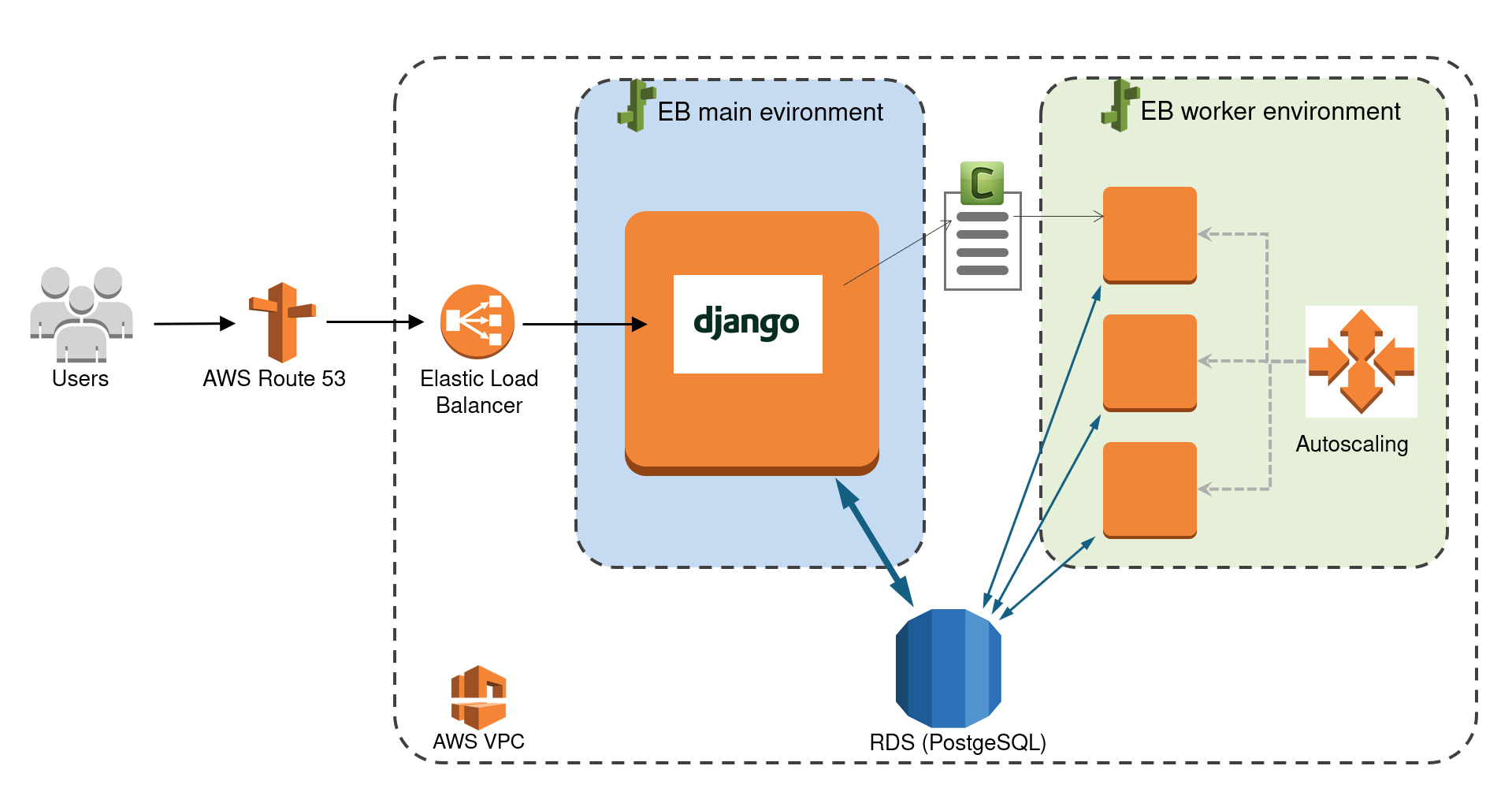
To speed up this process, I implemented an architecture where the Tree of Knowledge backend puts simulation tasks on a celery queue and there is a pool of workers (servers) that take tasks from the queue and run the simulations - see diagram below.
If the simulation is very big, then automatically further workers are started and join in.
The code for these workers can be found in this GitHub repository.
2020
15 Oct 2020
Practical application: Birth probabilities
Birth probabilities modelled by training on two very different datasets at once.
There already had been great work done in modelling the probability of a woman to give birth to a child in any given year.
For example, this research used a dataset called the "National Longitudinal Survey of Youth" to model this "birth probability".
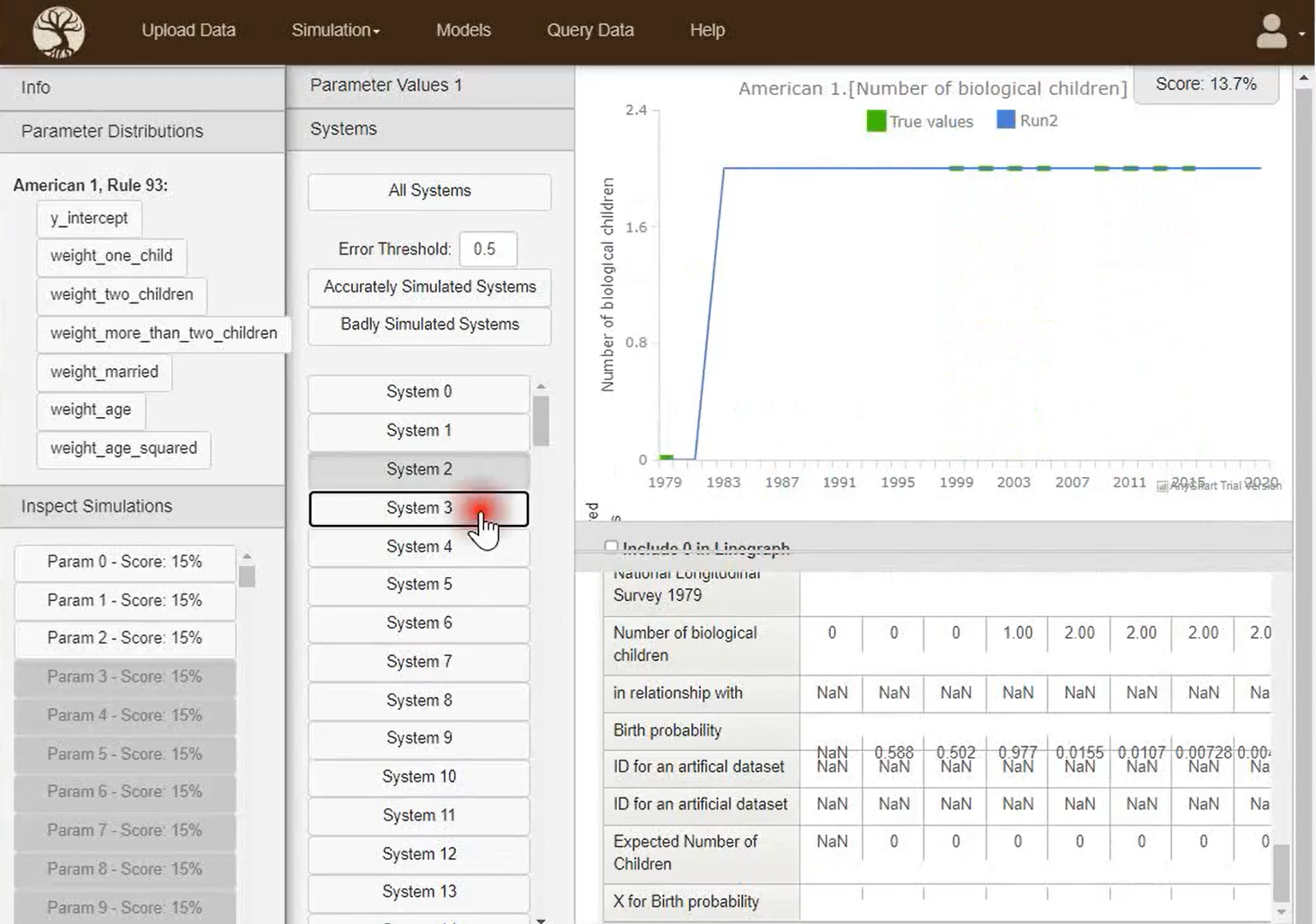
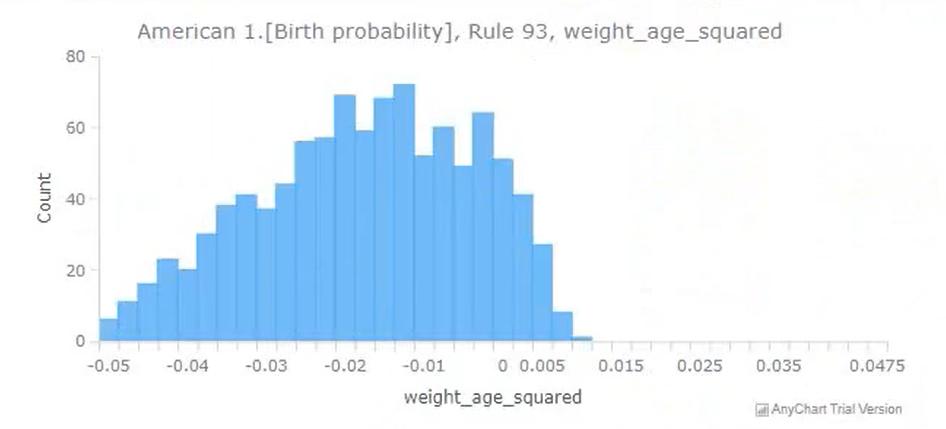
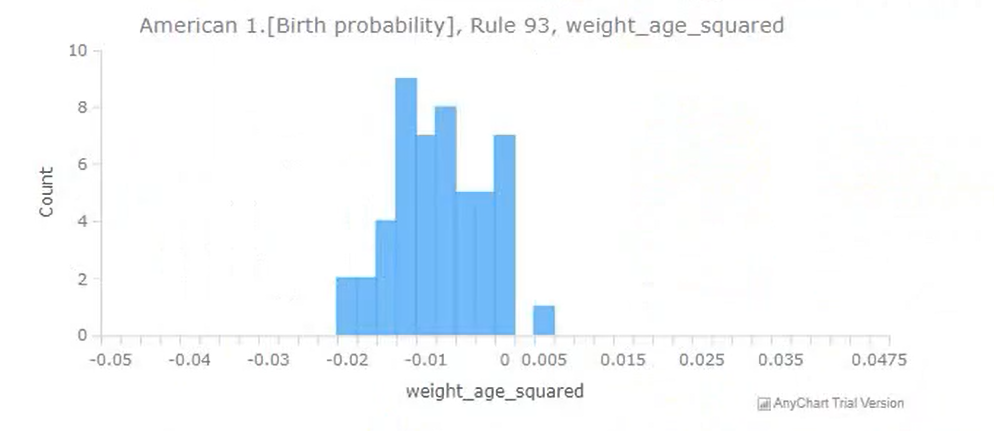
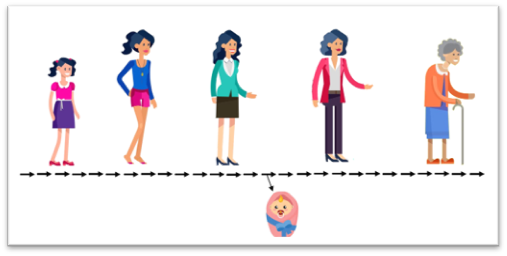
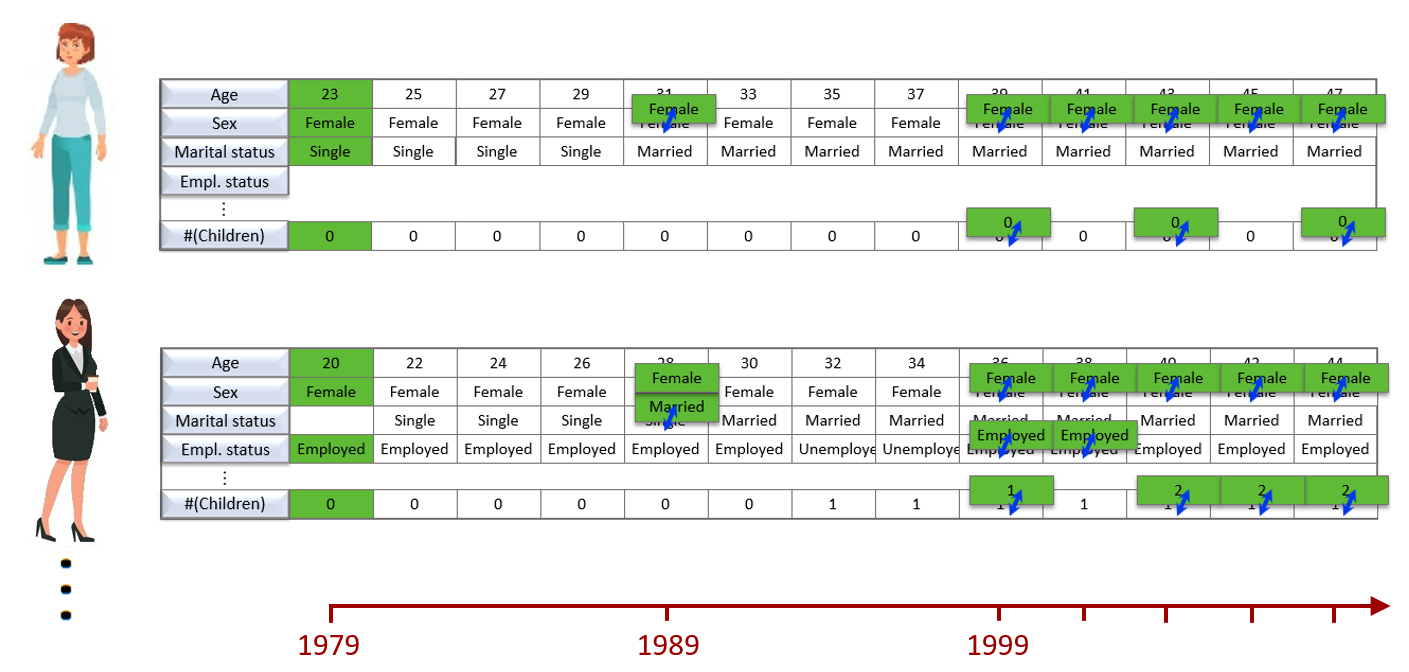
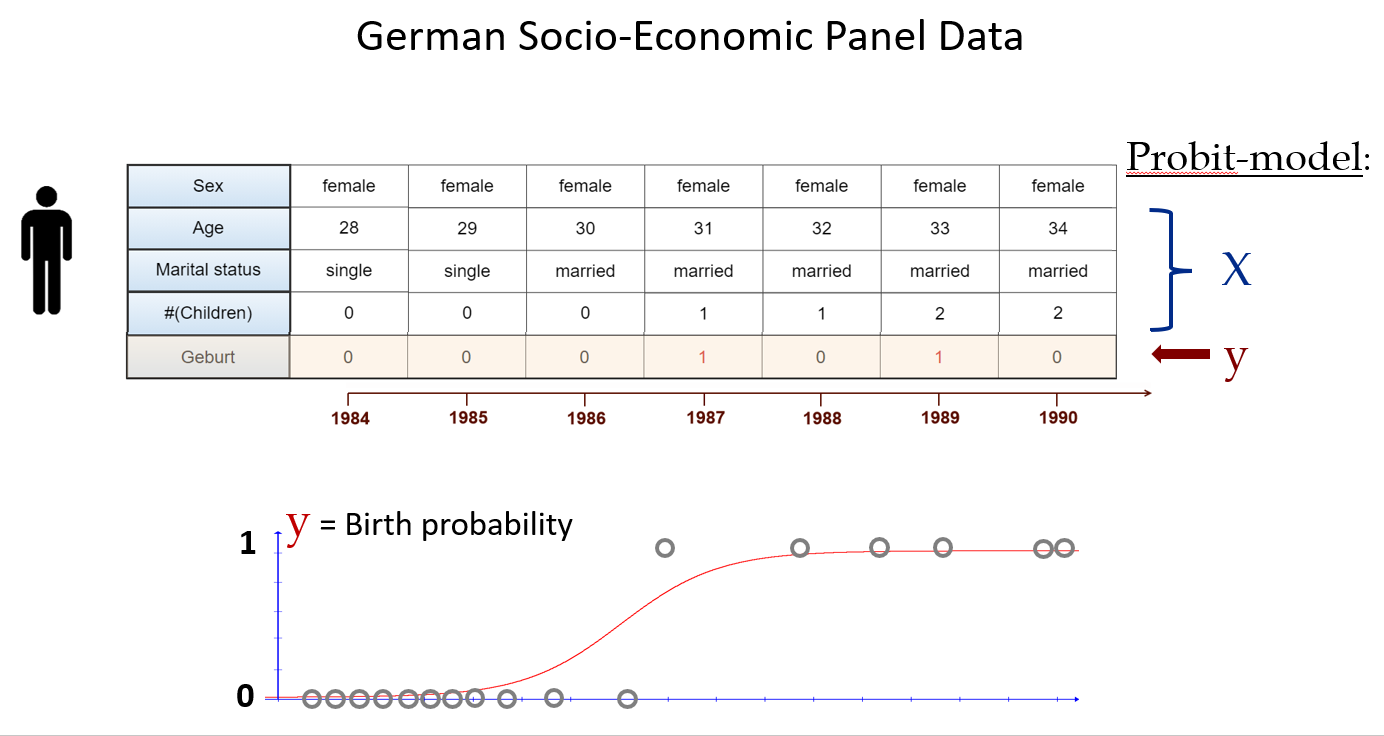
In order to demonstrate Tree of Knowledge's ability to get more accurate and reliable insights by training on multiple datasets, a very basic test was done - the same birth probability was modelled, but was trained on two datasets instead of the one: You can see that this is very different to a meta analysis, as the two datasets are very different: the National Longitudinal Survey of Youth contains data on individual people; the fertility rate data contains data on age-range-groups.
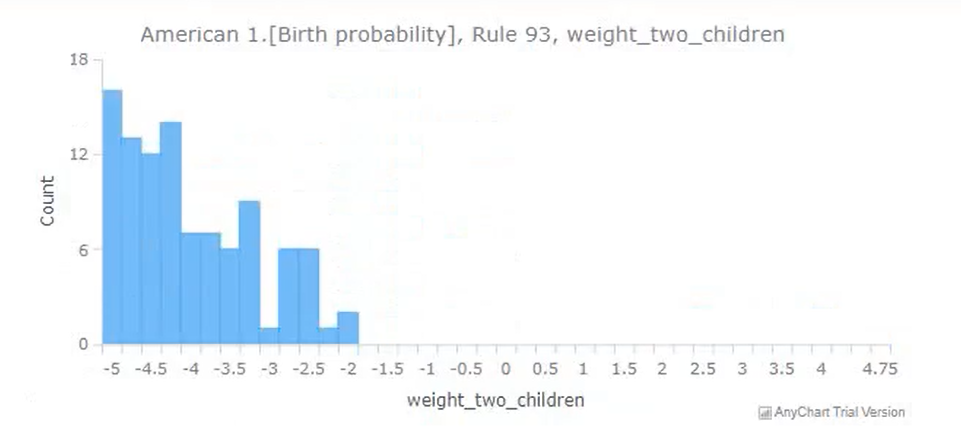
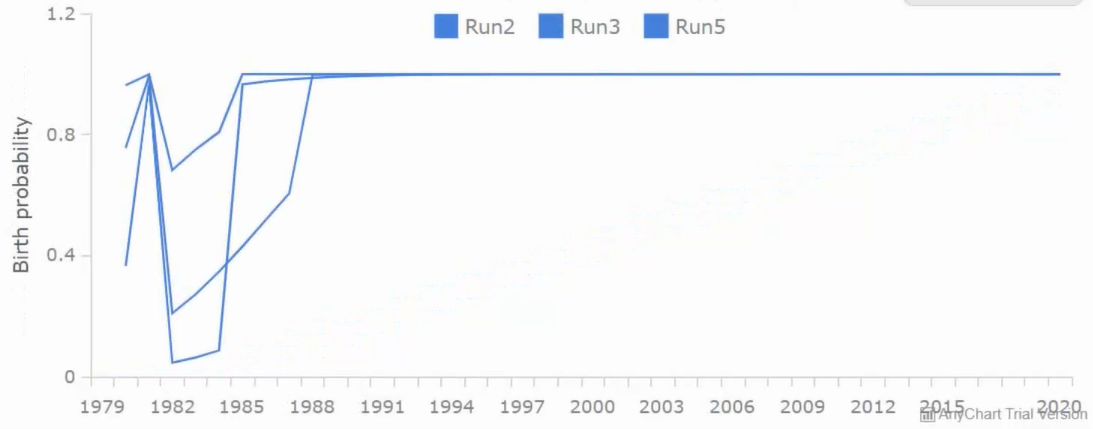
The test was a success, you can see some of the results below.
In order to demonstrate Tree of Knowledge's ability to get more accurate and reliable insights by training on multiple datasets, a very basic test was done - the same birth probability was modelled, but was trained on two datasets instead of the one: You can see that this is very different to a meta analysis, as the two datasets are very different: the National Longitudinal Survey of Youth contains data on individual people; the fertility rate data contains data on age-range-groups.
The test was a success, you can see some of the results below.
4 Oct 2020
Enable more complex behavior
Behavior rules gained two new options: aggregation and random numbers.
Behavior rules calculate the next timestep's value for a variable, using any of the current actor's own attributes or attributes of an agent related to the current actor.
When creating behavior rules you had the option to use one or more of the following options:
New option "Aggregation"
This allows variables such as a country's "Average fertility rate" to be calculated as aggregated value from many people/population groups.
New option "Random Number"
This allows for random values anywhere in the rule - see example below. The number is drawn from a uniform distribution between 0 and 1. This allows variables such as a country's "Average fertility rate" to be calculated as aggregated value from many people/population groups.
When creating behavior rules you had the option to use one or more of the following options:
- "If Condition" - condition that has to be satisfied for the rule to fire
- "Parameters" - unknown rule parameters that will be inferred using Bayesian Inference
- "Uncertain/Probabilistic rule" - probability for the rule to trigger; also inferred with Bayesian Inference
New option "Aggregation"
This allows variables such as a country's "Average fertility rate" to be calculated as aggregated value from many people/population groups.
New option "Random Number"
This allows for random values anywhere in the rule - see example below. The number is drawn from a uniform distribution between 0 and 1. This allows variables such as a country's "Average fertility rate" to be calculated as aggregated value from many people/population groups.
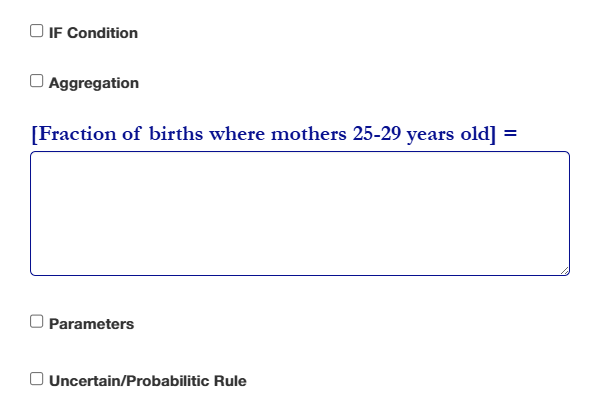
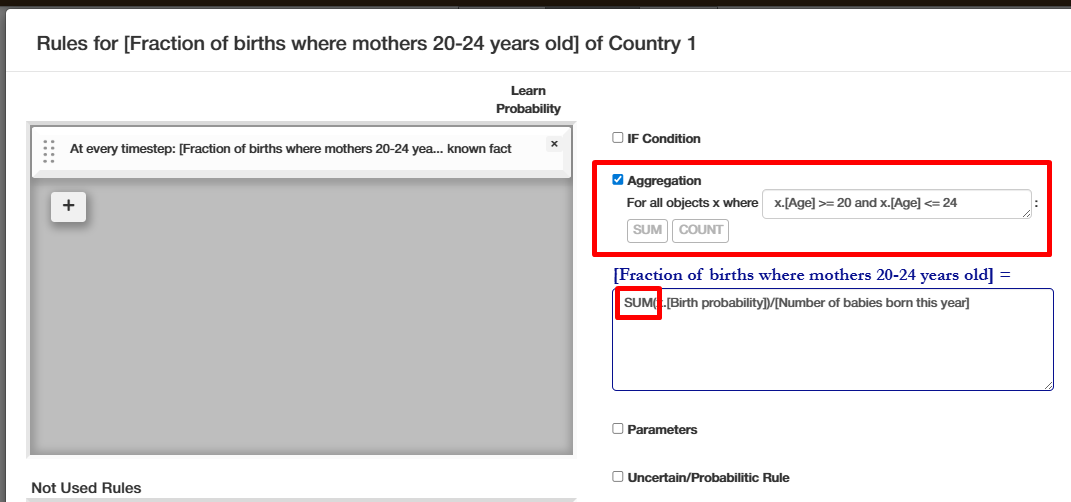
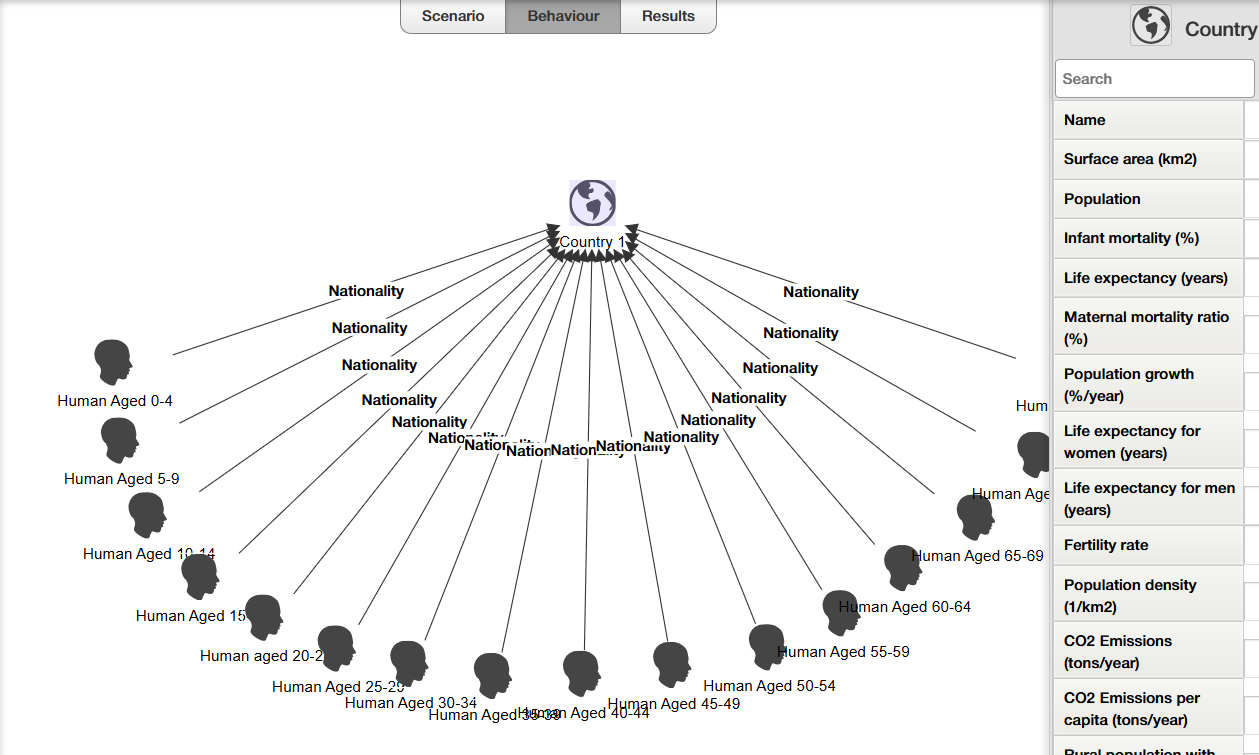
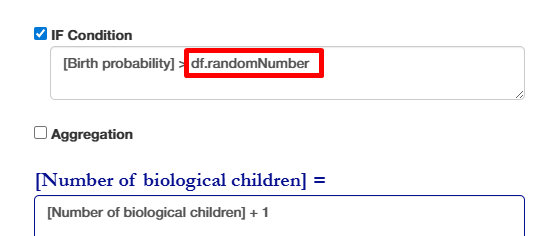
In the above example, [Birth probability] is a value between 0 and 1 that gives the probability of a woman to give birth this year.Let's say, that the [Birth probability] is 0.05 (i.e. a 5% chance to give birth this year).
Now, every year this rule is executed once and everytime a new randomNumber between 0 and 1 is drawn.
This means that for any given year there is a 5% chance that the condition is fullfilled (randomNumber < [Birth probability]) and the woman's number of children is incremented by one
18 Jul 2020
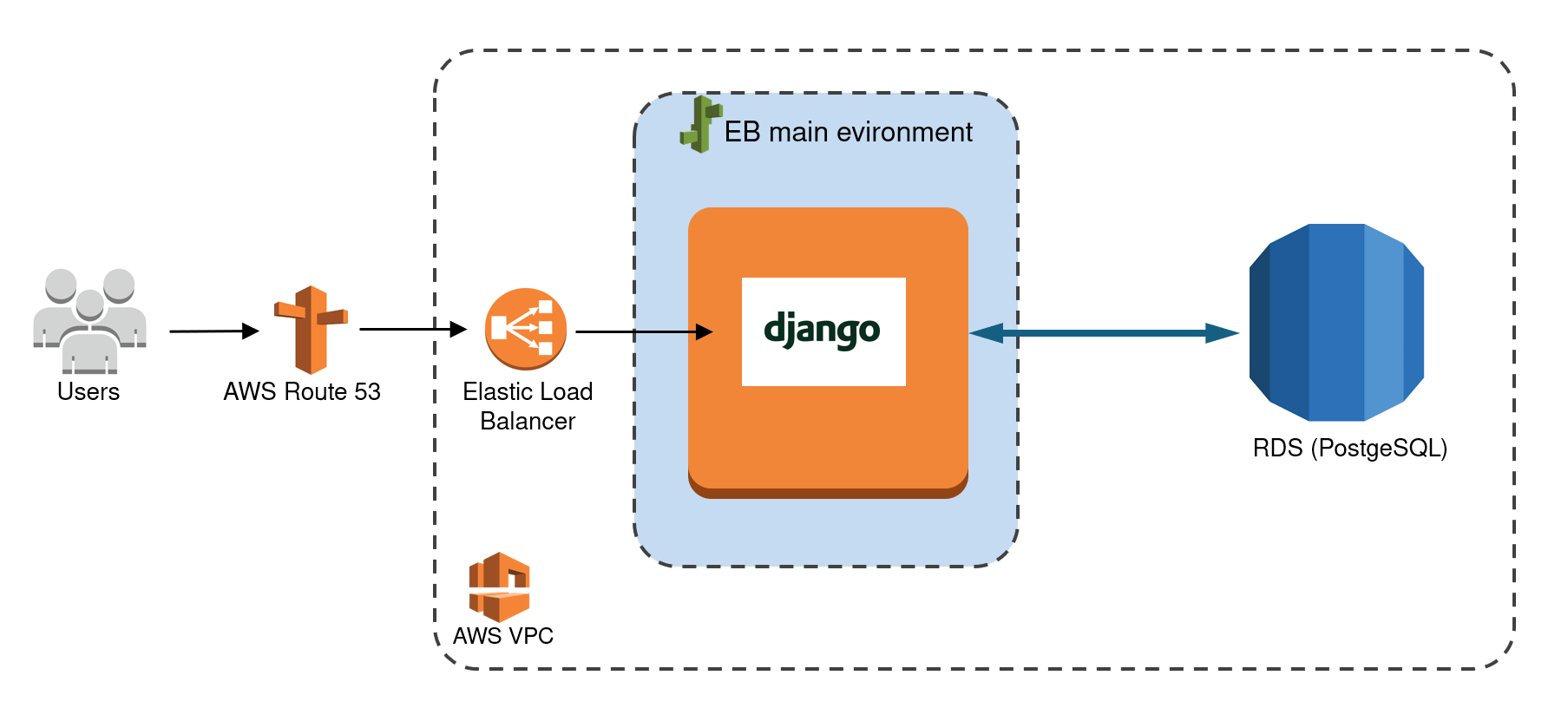
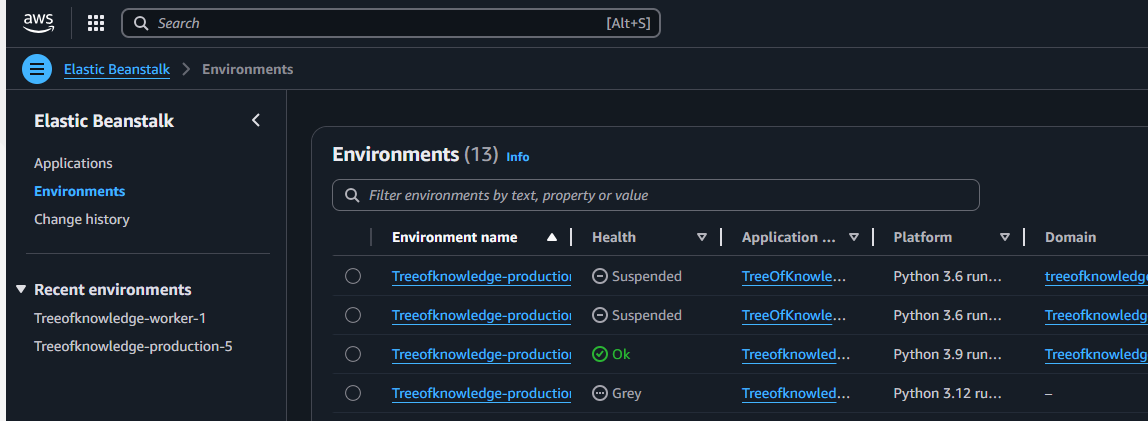
Migration from Heroku to AWS
The platform moved to AWS to scale up simulation capacity.
This webservice/online platform had been hosted on servers from the Cloud Provider "Heroku".
The server was getting too slow for running intensive simulations and Heroku however only offers limited options for scaling. It was therefore necessary to migrate the webservice to AWS.
23 May 2020
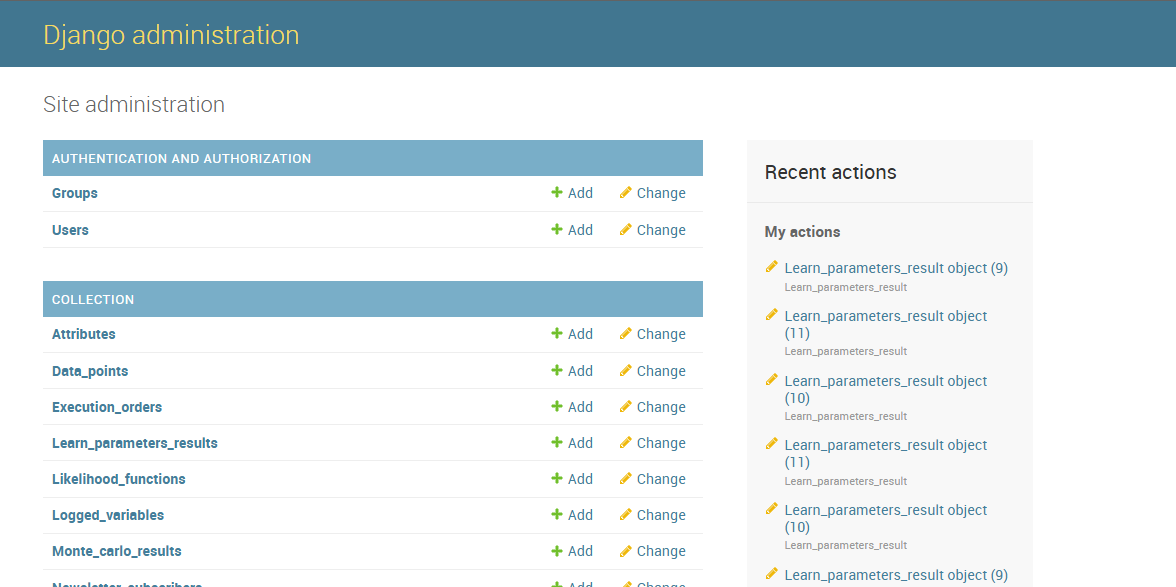
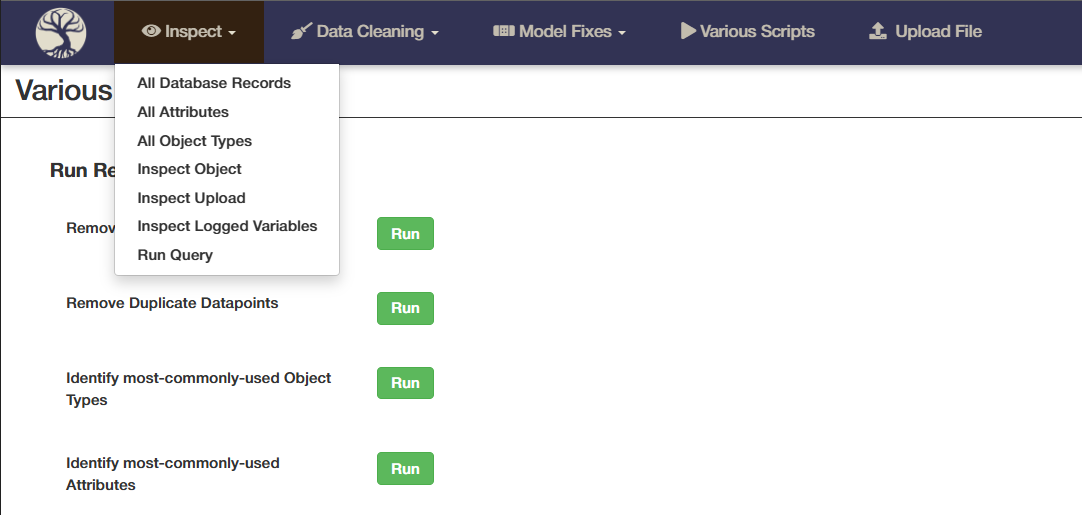
Admin Pages completed
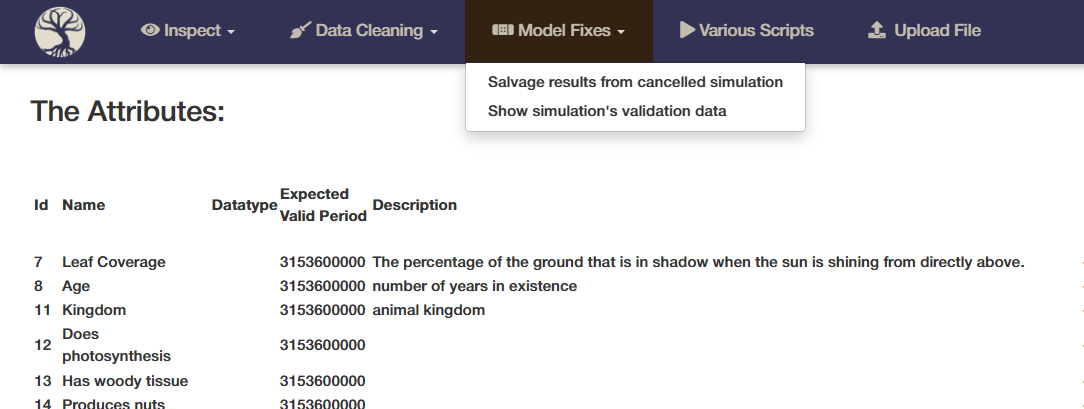
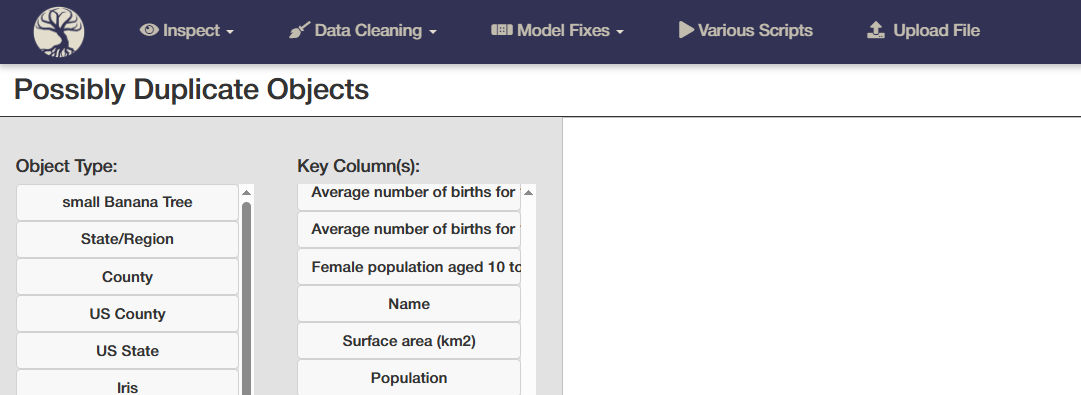
New admin pages for monitoring and managing the platform and Knowledge Base.
In order to monitor and manage this online platform (especially the Knowledge Base), specific Admin pages were created which are only accessible for users with admin rights.
30 Apr 2020
Result Inspector & Simulation Inspector completed
New pages for inspecting inference results and individual simulations in detail.
Result Inspector
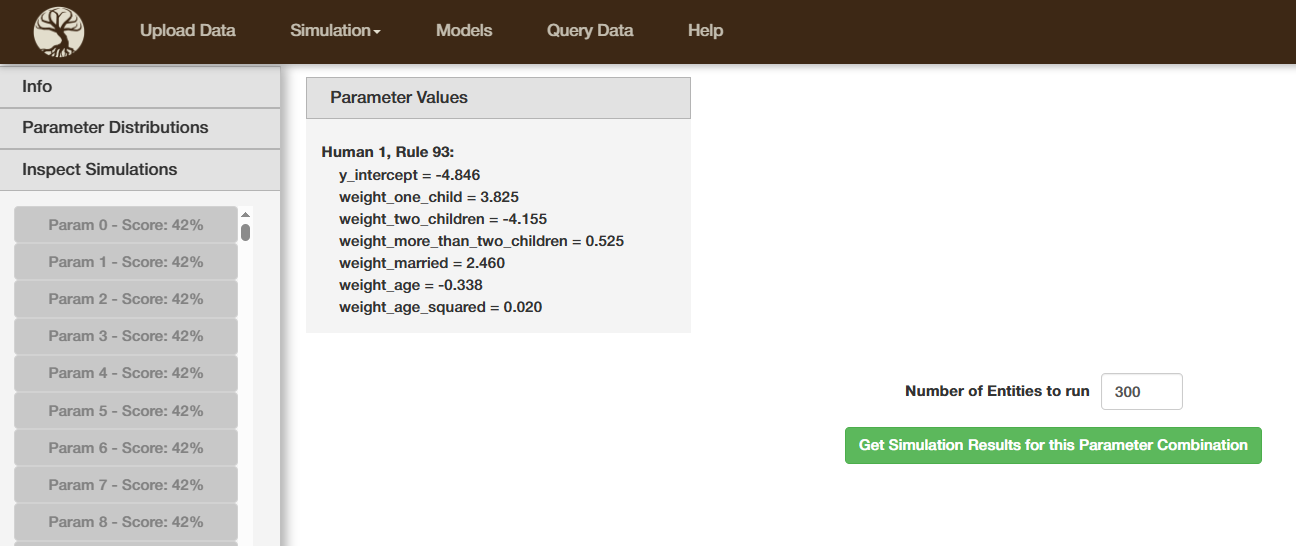
These pages allow you to inspect the details of the Bayesian Inference.
Notably, they allow you to see
Simulation rules sometimes have unexpected consequences. It is therefore very important to be able to inspect every/any simulation in detail and see where it potentially went wrong...
From the Result Inspector pages (see last paragraph) you can select a simulation to be shown in more detail. The system will then re-run this simulation while exactly logging everything that occurs, and display the folllowing simulation details in the Simulation Inspector pages:
These pages allow you to inspect the details of the Bayesian Inference.
Notably, they allow you to see
- How well each simulation performed - how accurately the simulations mimicked the real world/ how well it reproduced the observed data.
- The parameter values that led to specific simulations working well/not so well
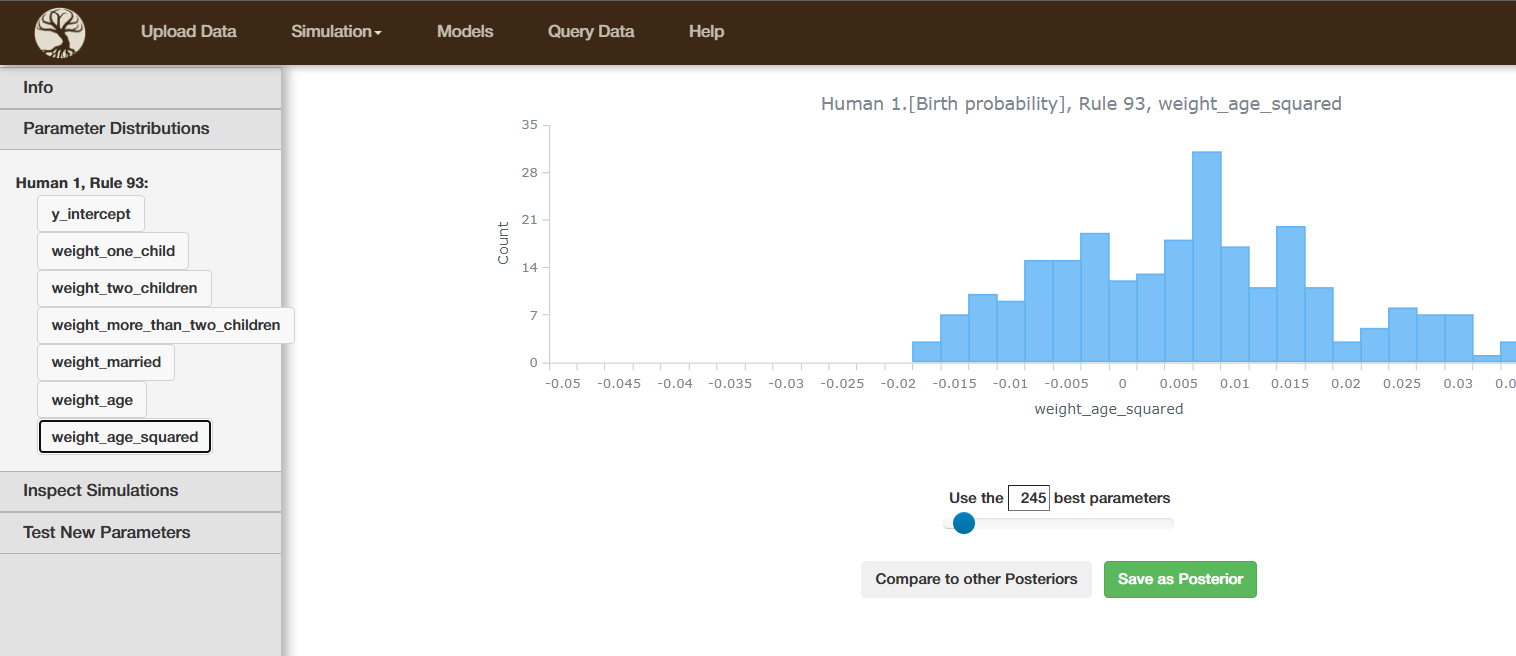
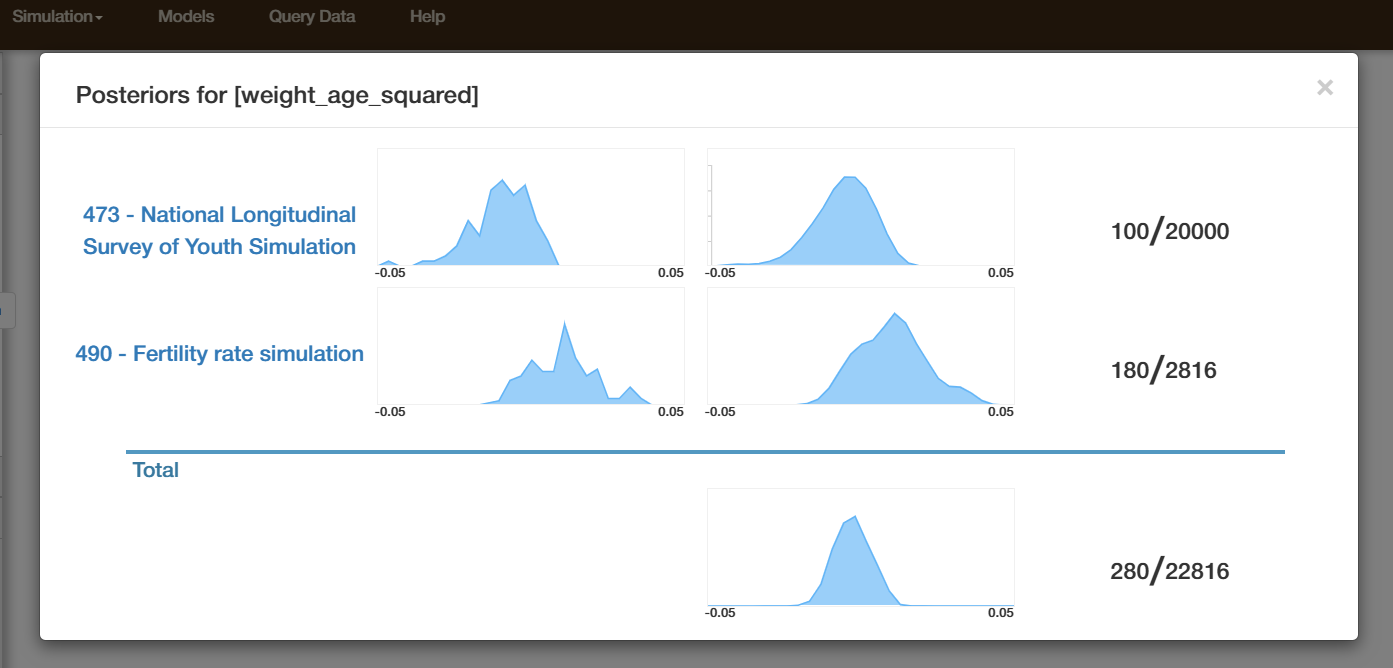
- Posterior distributions depending on the threshold ε
According to Approximate Bayesian Computation (ABC) logic, you can try out different values for the threshold ε and see how the posterior distribution is affected by this threshold.
Simulation rules sometimes have unexpected consequences. It is therefore very important to be able to inspect every/any simulation in detail and see where it potentially went wrong...
From the Result Inspector pages (see last paragraph) you can select a simulation to be shown in more detail. The system will then re-run this simulation while exactly logging everything that occurs, and display the folllowing simulation details in the Simulation Inspector pages:
- Comprehensive table of all values at all timesteps
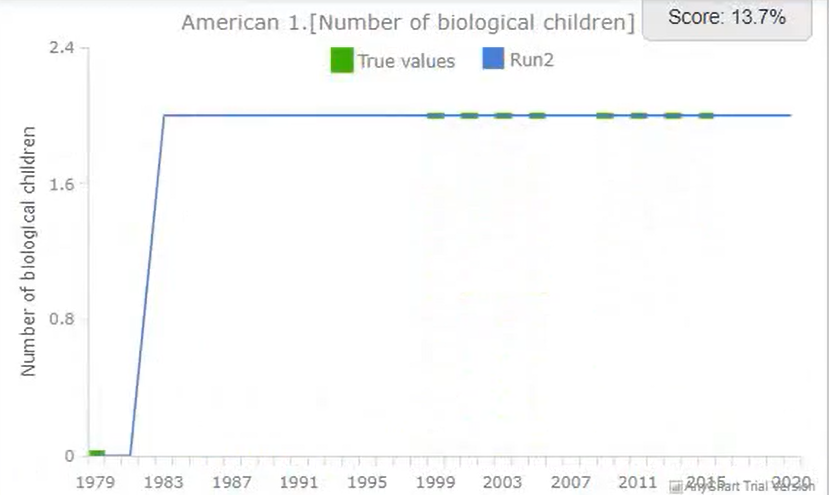
- Graph to show the evolution of an attribute. It can also show this attribute evolution for many simulations simultaneously - allowing for comparisons and trend analysis
- Executed rules
For every timestep, it shows exactly which rules were executed in which order - allowing for detailled debugging
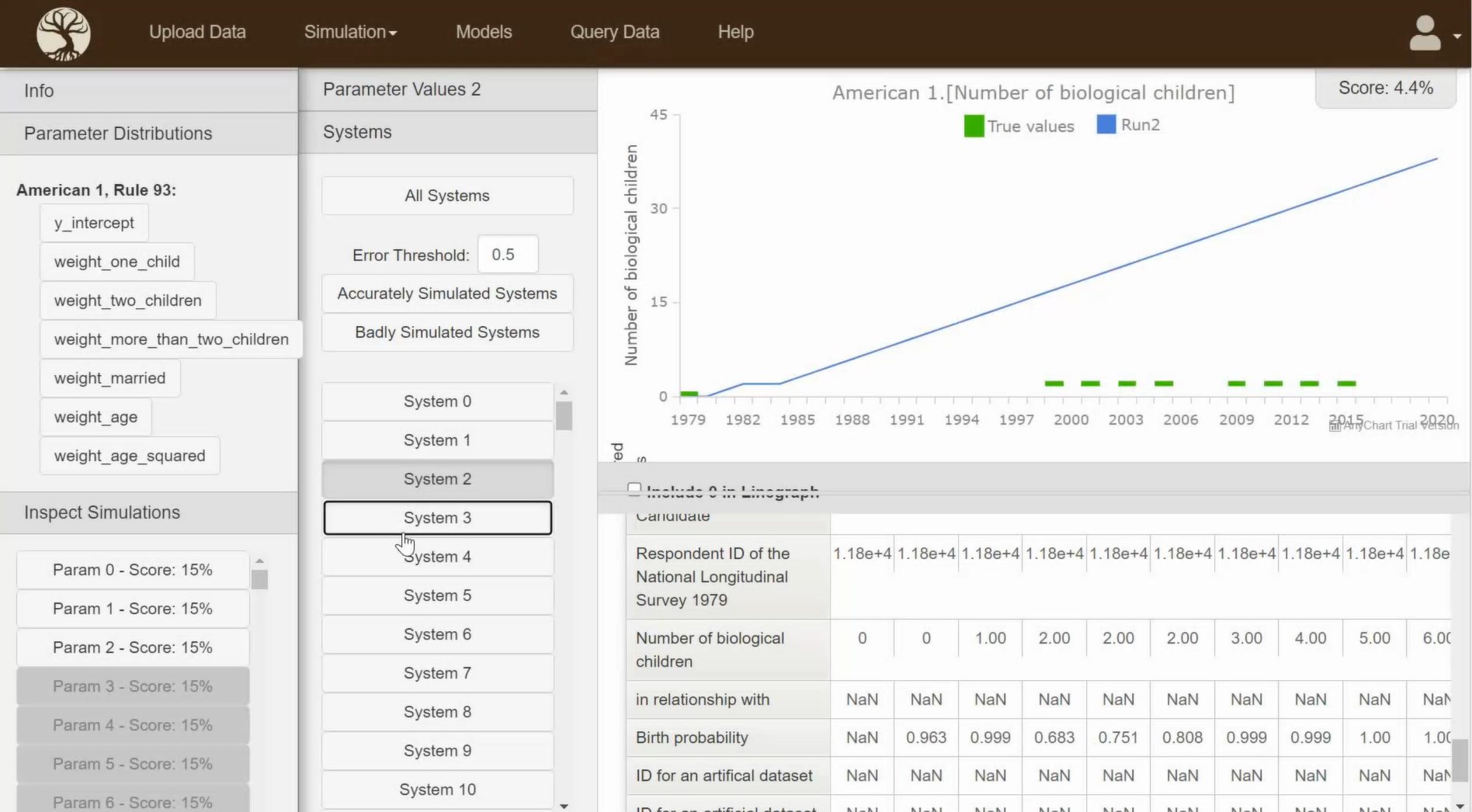
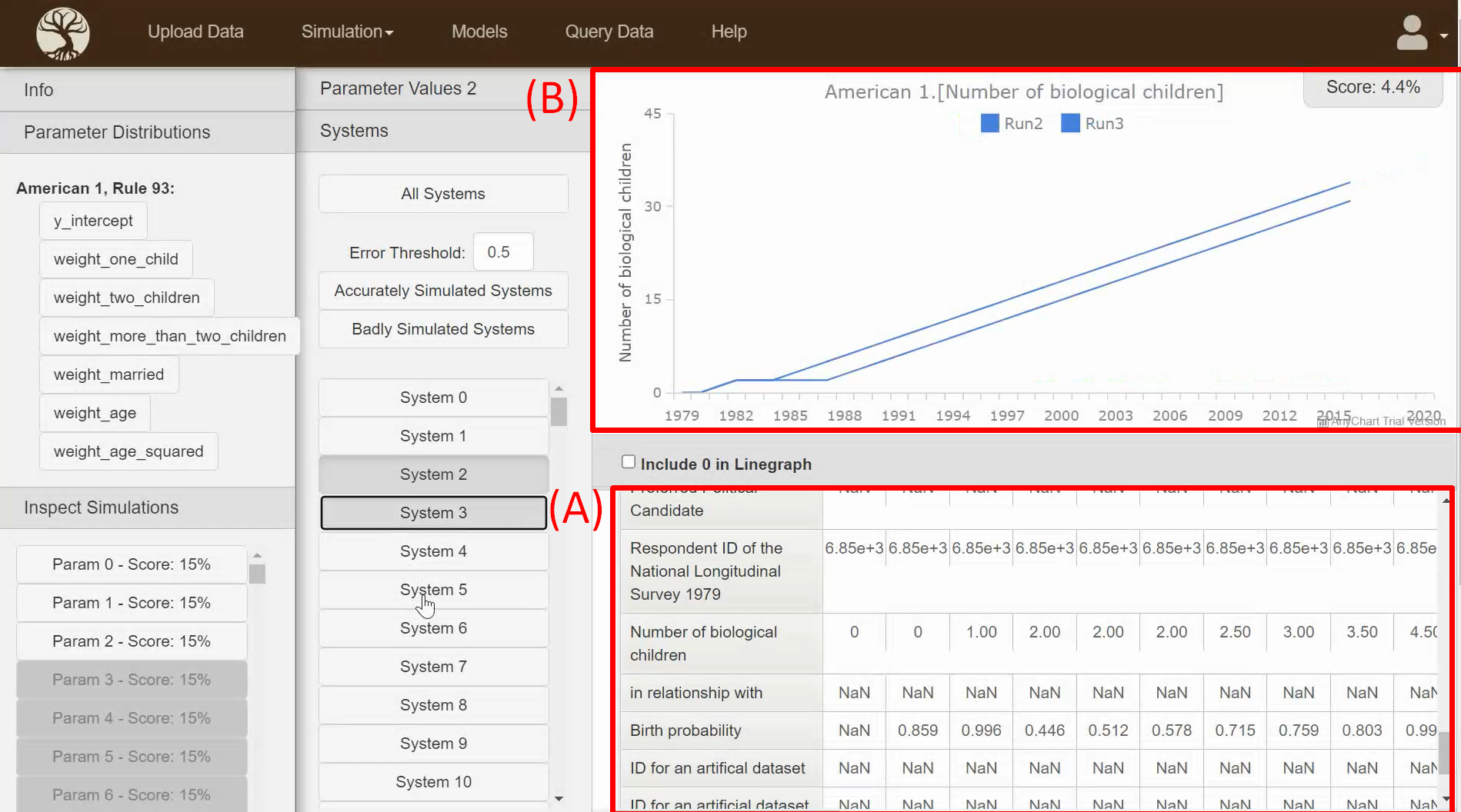
(B) Graph showing the evolution of whatever attribute you selected in table (A)
2019
11 Nov 2019
Rule Editor & Rule Parameters completed
Create behavior rules with conditions, inferred parameters and probabilities.
The agent's behavior rules is what makes everything run. Tree of Knowledge's core mission is to find the correct behavior rules for humans and other social agents.
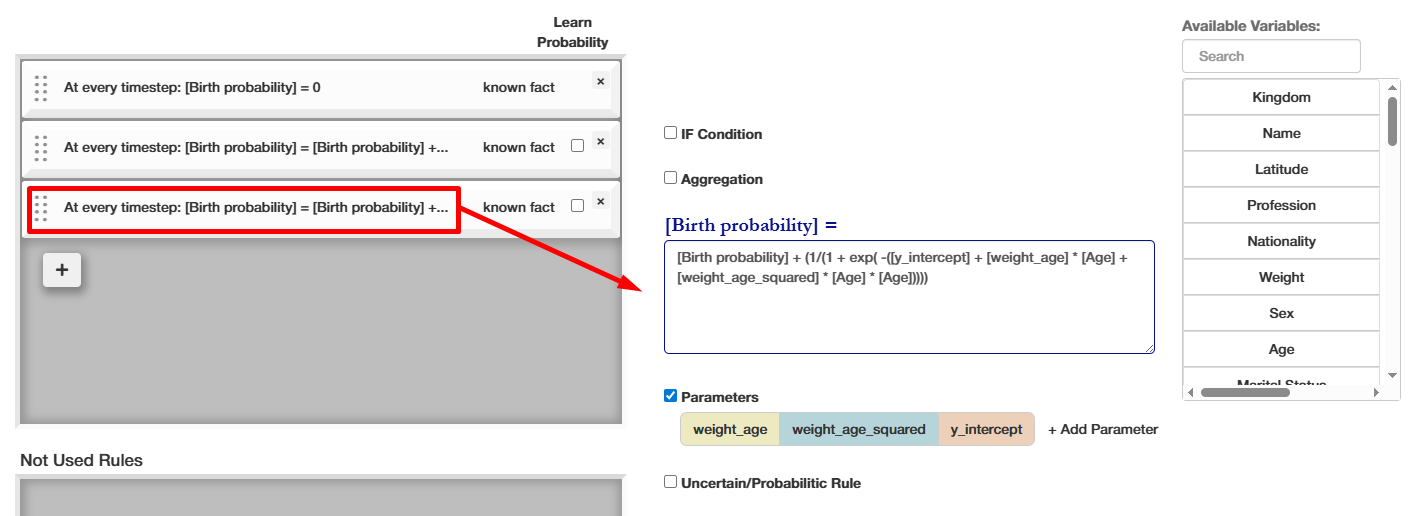
A Rule is a calculation of the next timestep's value for an attribute. To allow you to create versatile and expressive behavior rules, you have the following options:
A Rule is a calculation of the next timestep's value for an attribute. To allow you to create versatile and expressive behavior rules, you have the following options:
- "If Condition" - condition that has to be satisfied for the rule to fire
- "Parameters" - unknown rule parameters that will be inferred using Bayesian Inference
- "Uncertain/Probabilistic rule" - probability for the rule to trigger; also inferred with Bayesian Inference
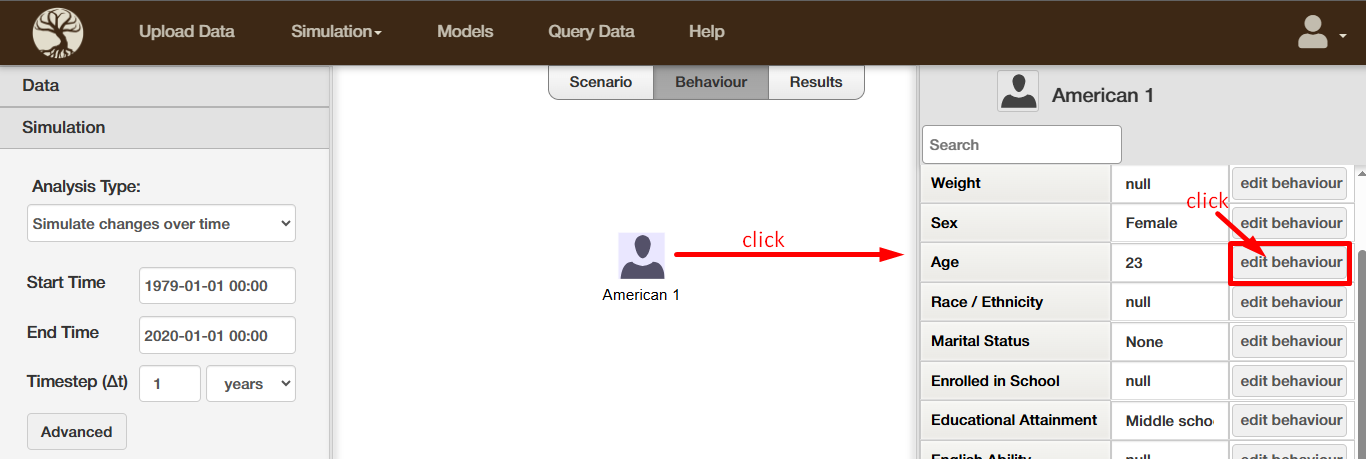
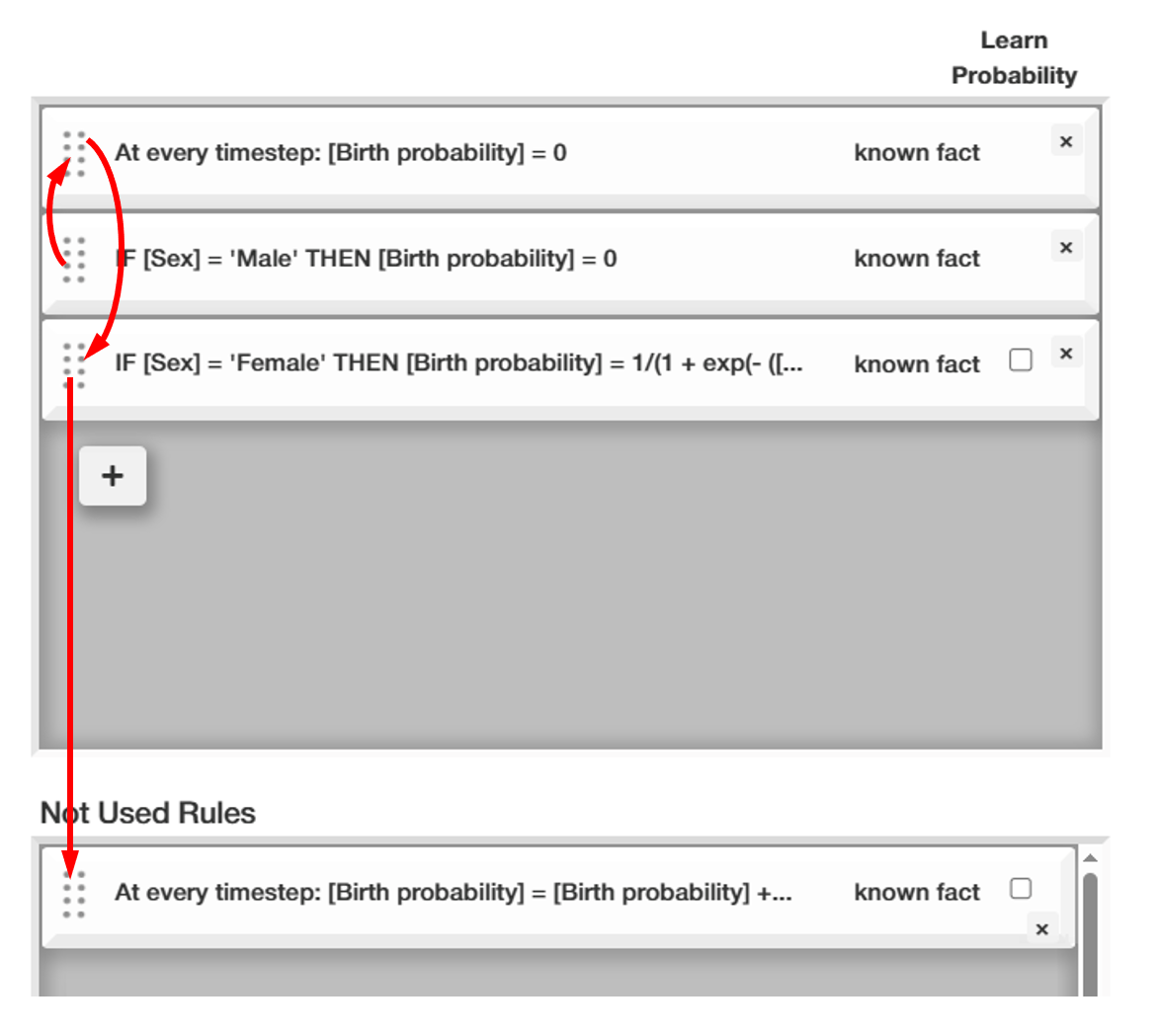
During the simulation, rules are executed after each other from top to bottom. By drag&dropping them, you can change the execution order or completely remove them from the next run.
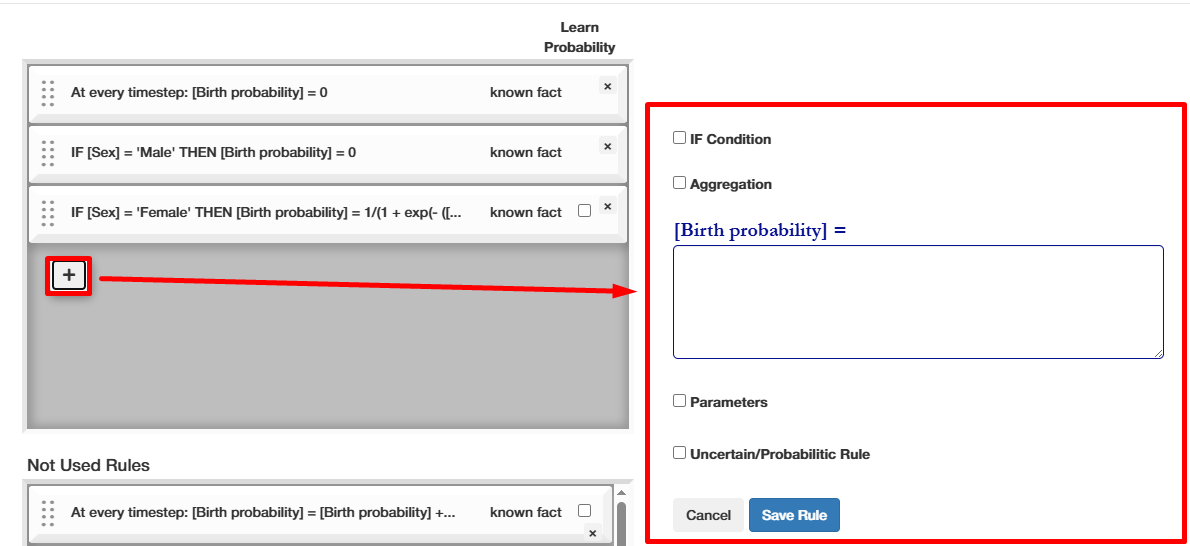
A model/theory is a complete set of behvior rules. The default model is the best performing one, but you can also work on an alternative theory if you prefer
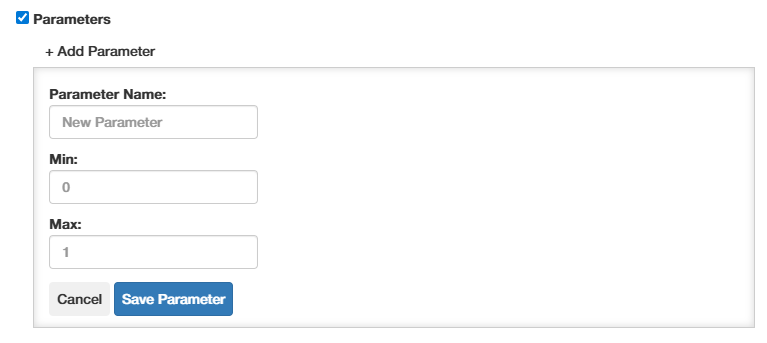
Currently, all rule parameters start off with a uniform prior in the predefined range (this might be extended in future). The prior distribution will however get updated with by the different inference runs (= dataset+models).
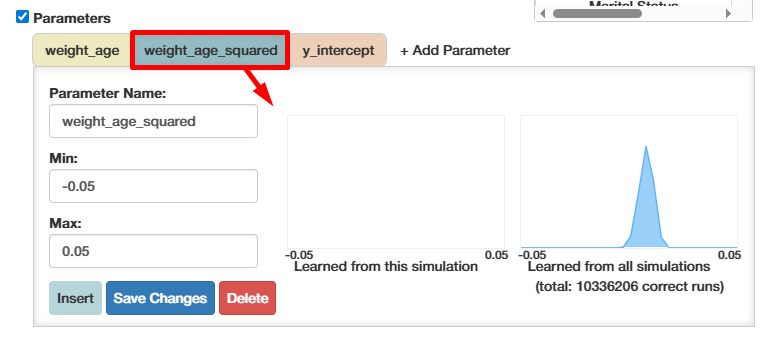
As you can see, the inferred posterior is displayed, too
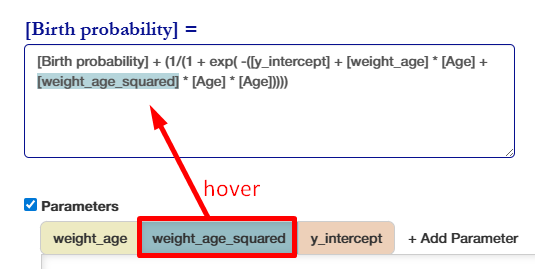
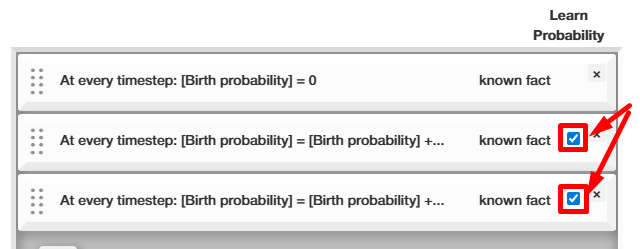
By selecting only 1-2 rules for inference, the number of to-be-inferred parameters is kept low. This is critical for keeping the inference time low, which starts balooning with more than seven parameters.
16 Jul 2019
Simulation Editor created
Set up a simulation's agents, relationships, duration and timestep size.
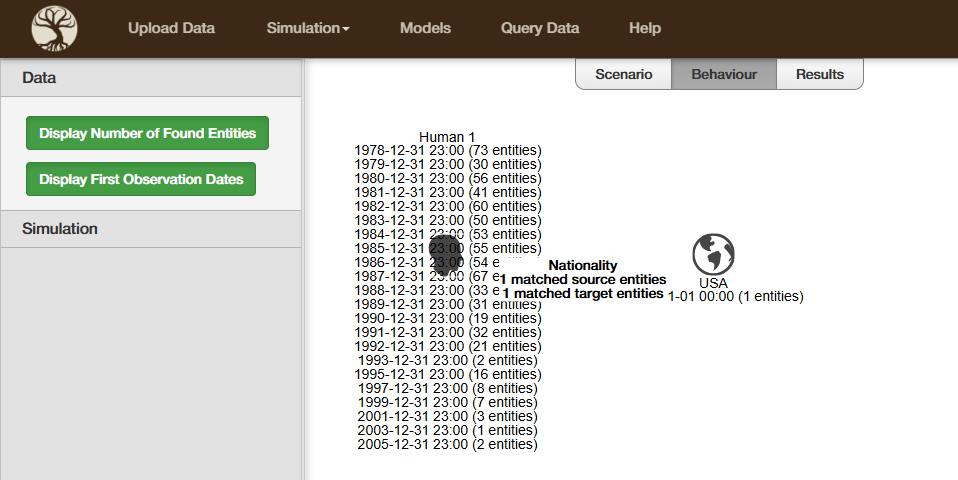
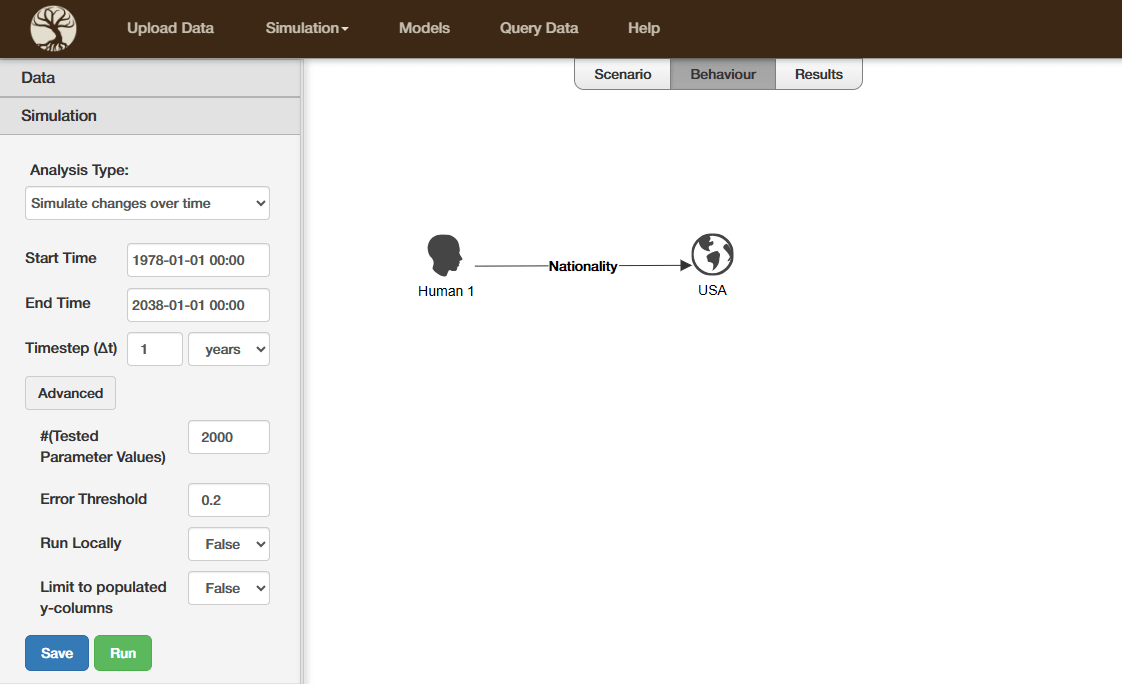
With the Simulation Editor, you set up a simulation.
This includes specifying:
Generally, you would want to run a simulation for one of the following reasons:
- the initial configuration of a simulation
- the simulation duration
- the timestep size
Generally, you would want to run a simulation for one of the following reasons:
- "Inference from a dataset"
This is done by specifying a simulation that mimicks the real-world environment in which a dataset was captured. The Inference then happens through fitting this simulation to the real-world data.
If you uploaded a dataset, then this simulation environment will be set up for you - using the meta data you specified during the uploading - "Prediction of a completely new setting"
You can specify any social system. If you press run, it will be simulated and you can see what mechanisms drive it and how it unfolds.
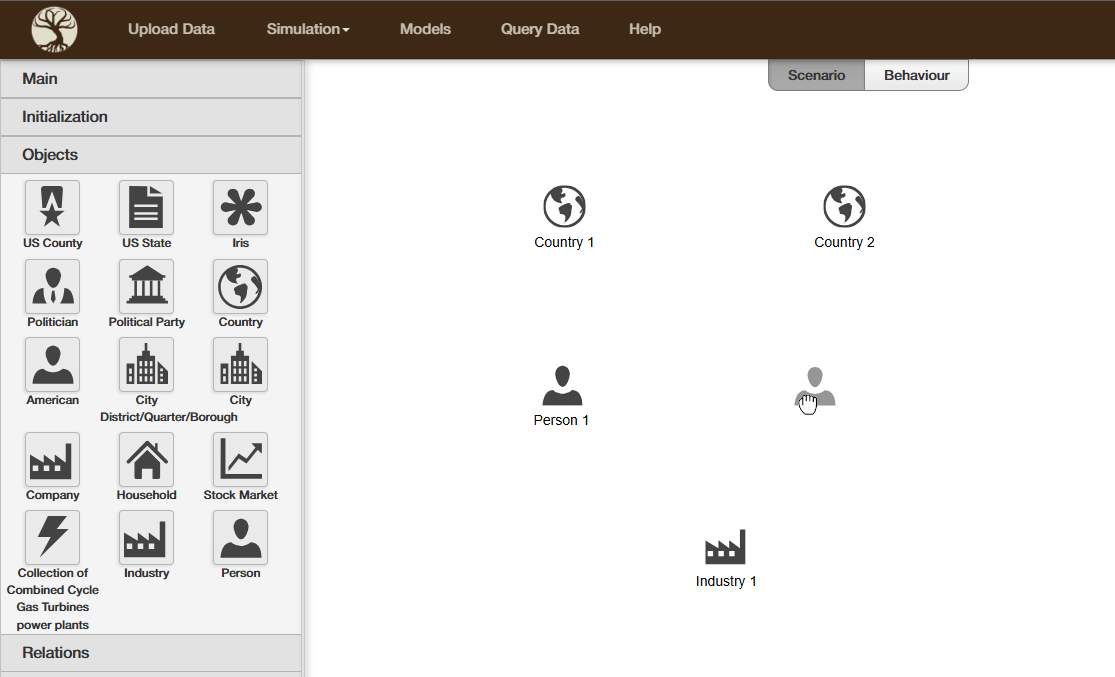
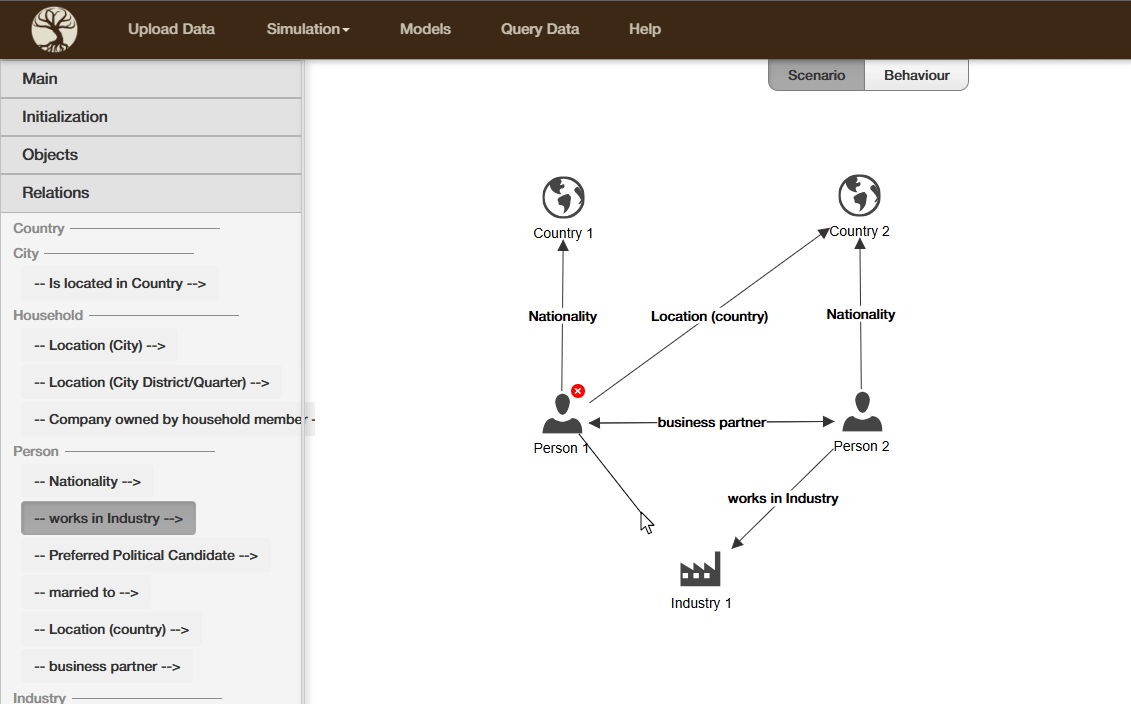
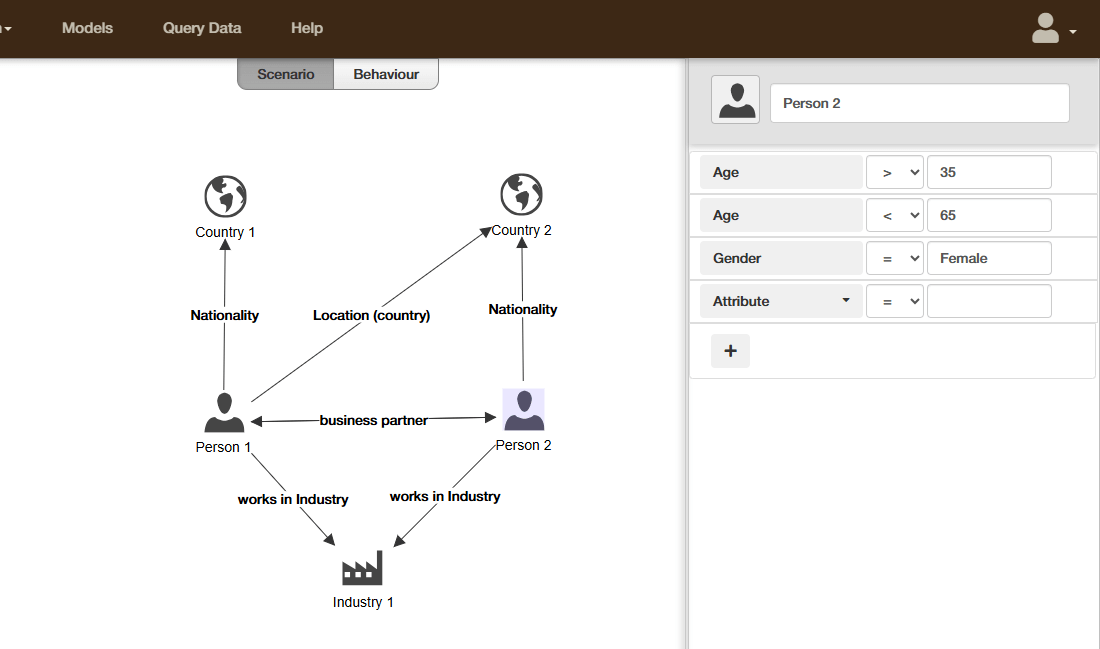
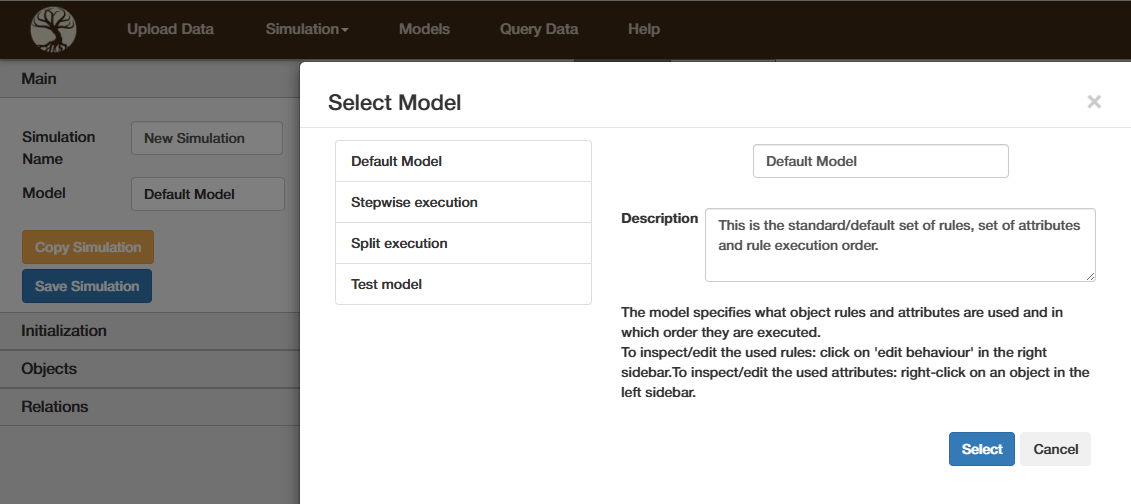
A model/theory is a complete set of behvior rules. The default model is the best performing one, but you can also run the simulation with an alternative theory if you prefer
29 Jan 2019
Upload Data/Integrate in Knowledge Base
A six-step upload process that integrates datasets into the Knowledge Base.
Uploading data to Tree of Knowledge involves 6 steps of clarifying meta-data about the dataset.
These are considerably more steps than with any other statistics software. On the other hand, once you've gone through the uploading process, the knowledge base knows everything there is to know about the data and handles all data related tasks for you.
This includes:
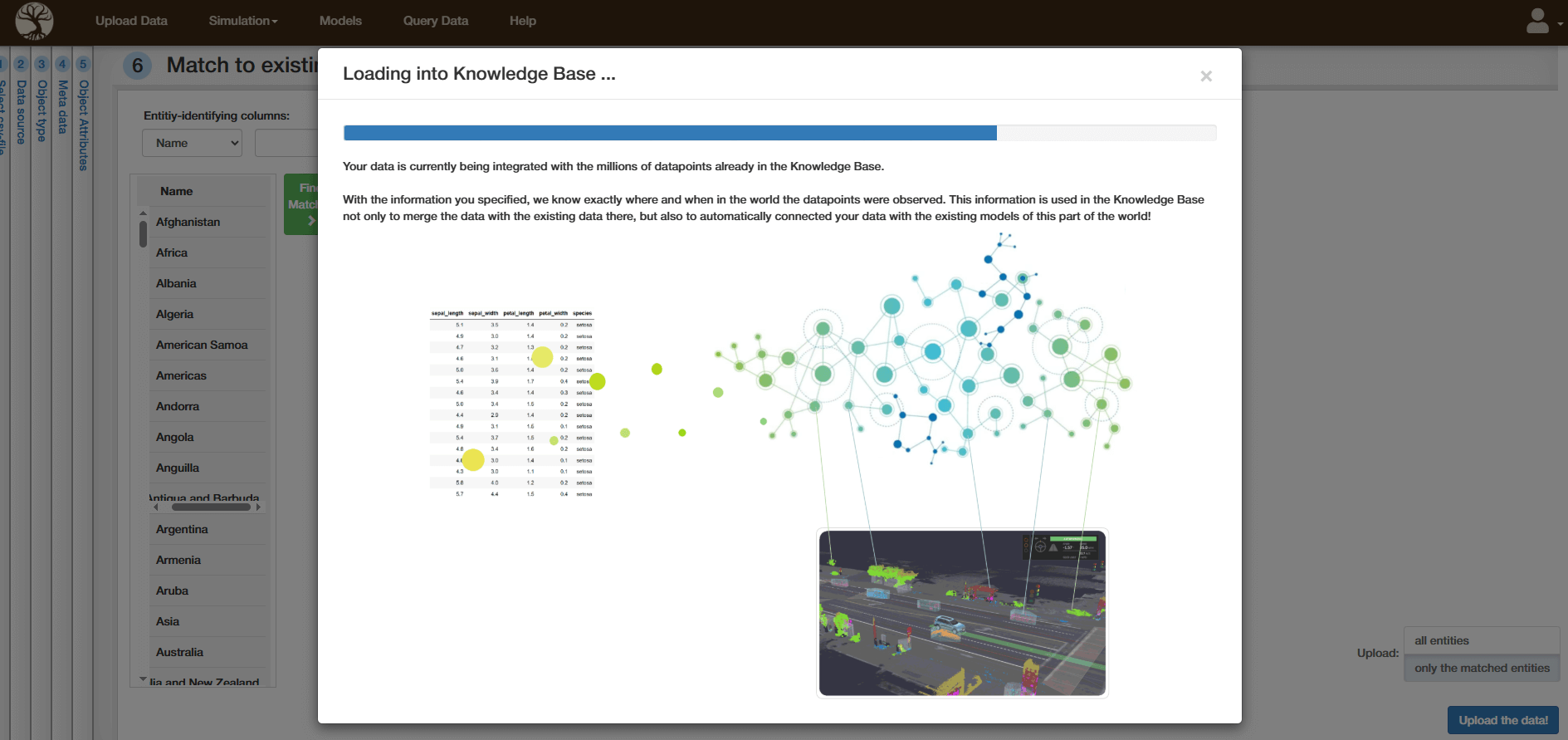
- automatically transforming integrating your data with the existing data in the Knowledge Base
- autmomatically preparing a simulation of the system observed by the data
- automatically managing the inference of this simulation
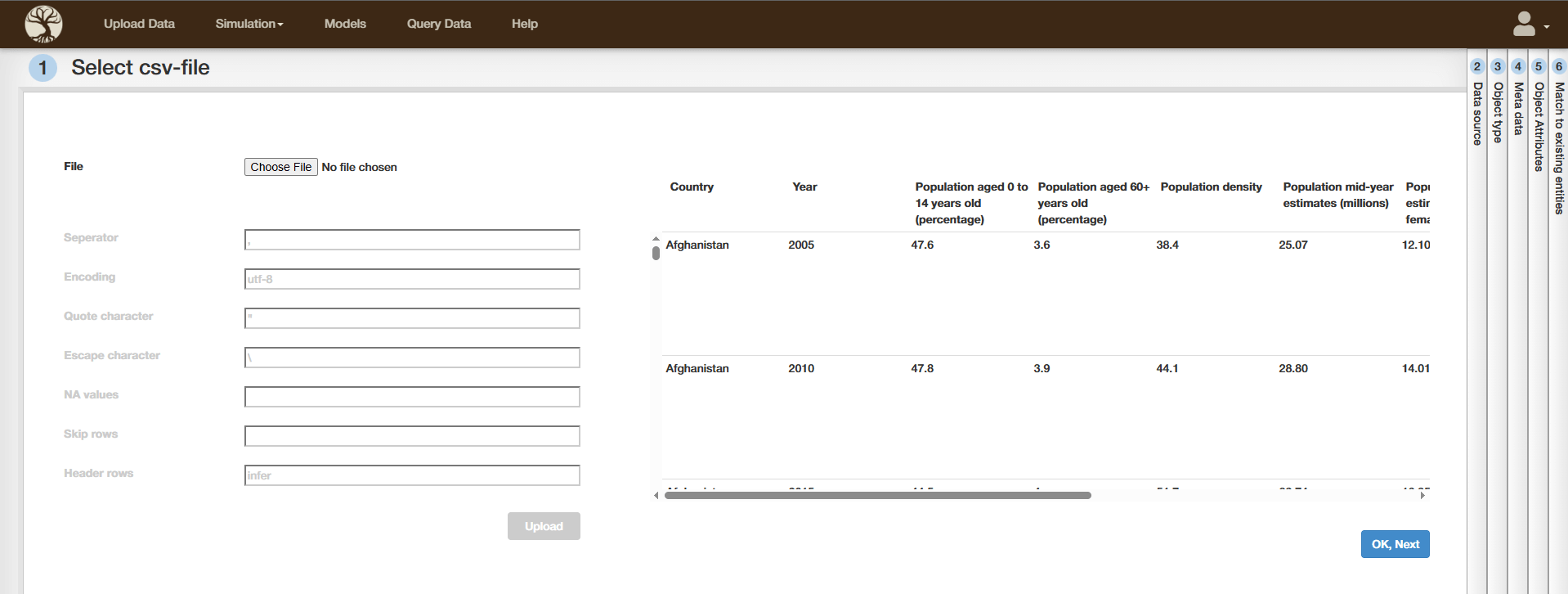
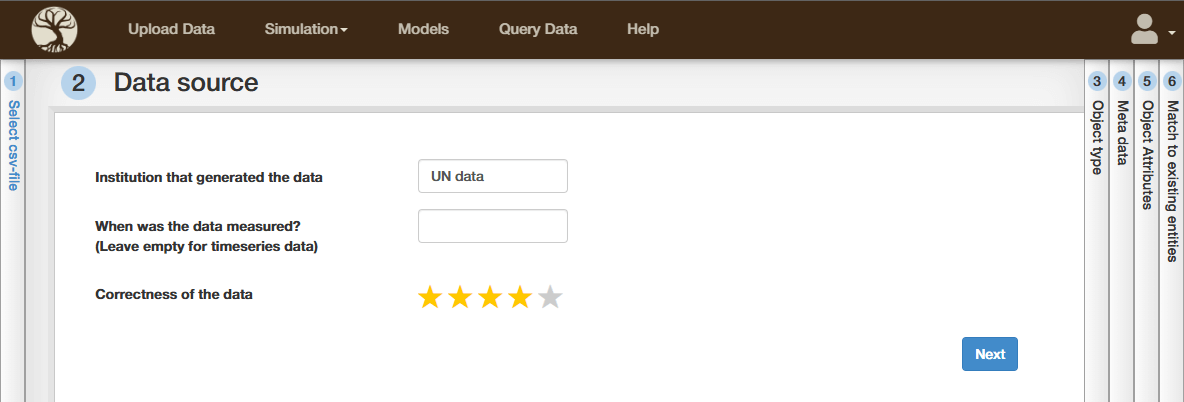
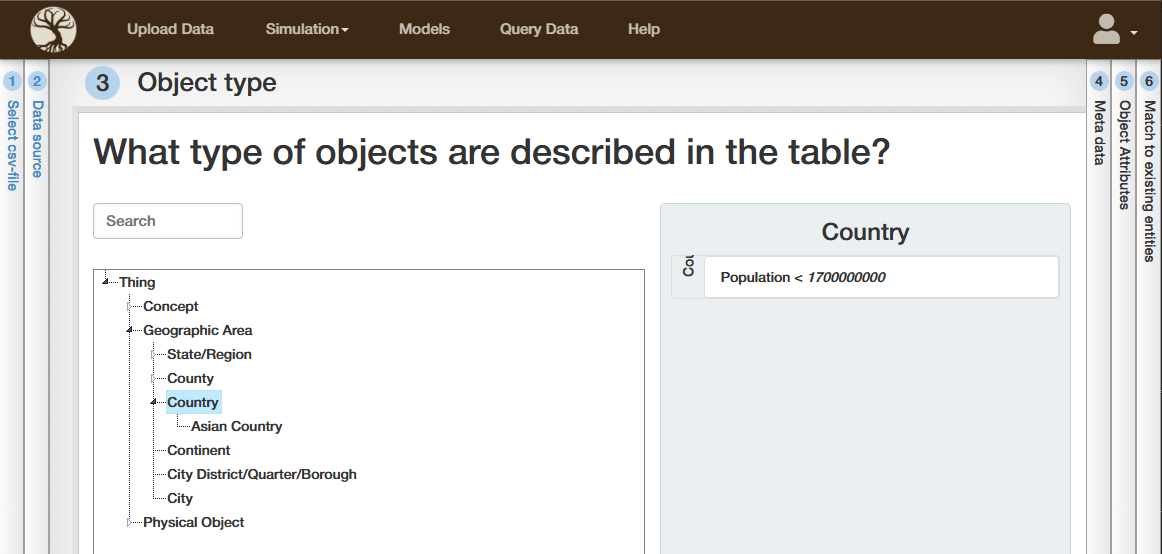
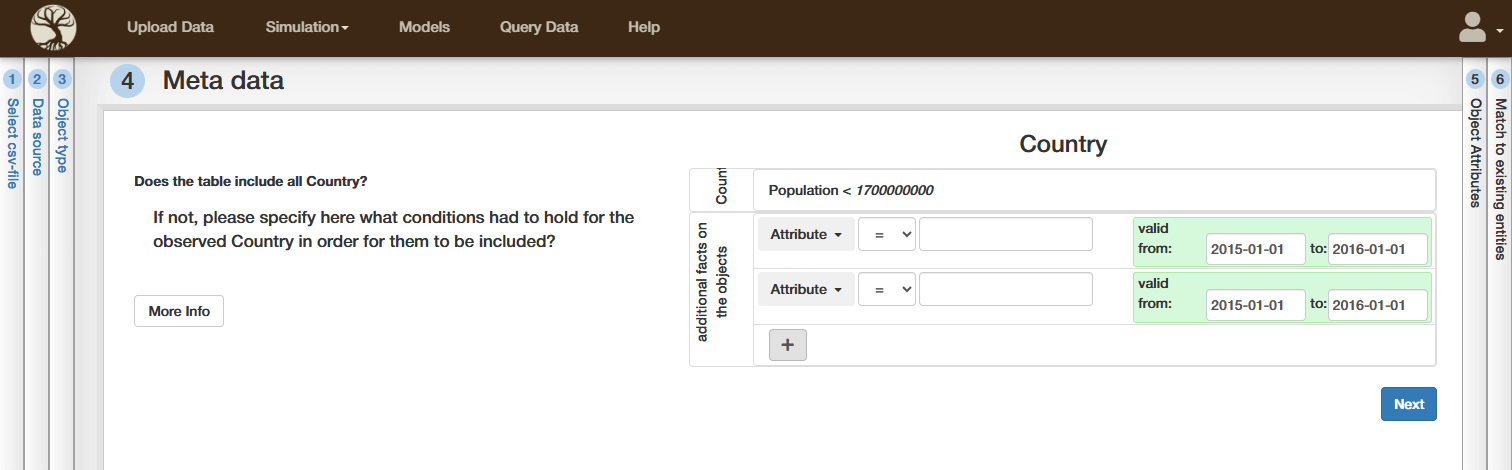
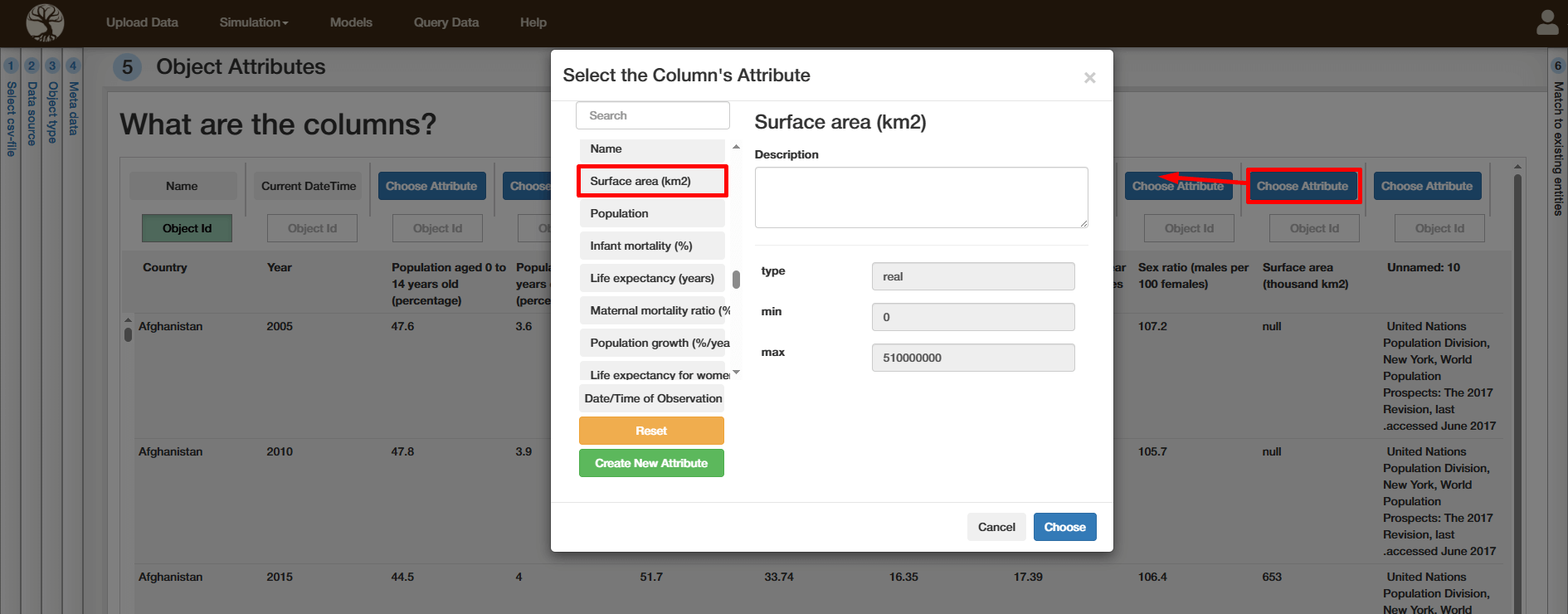
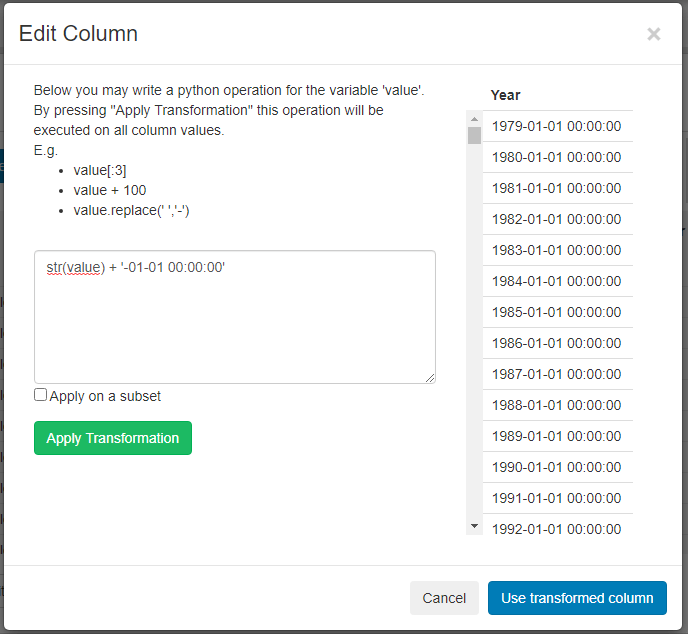
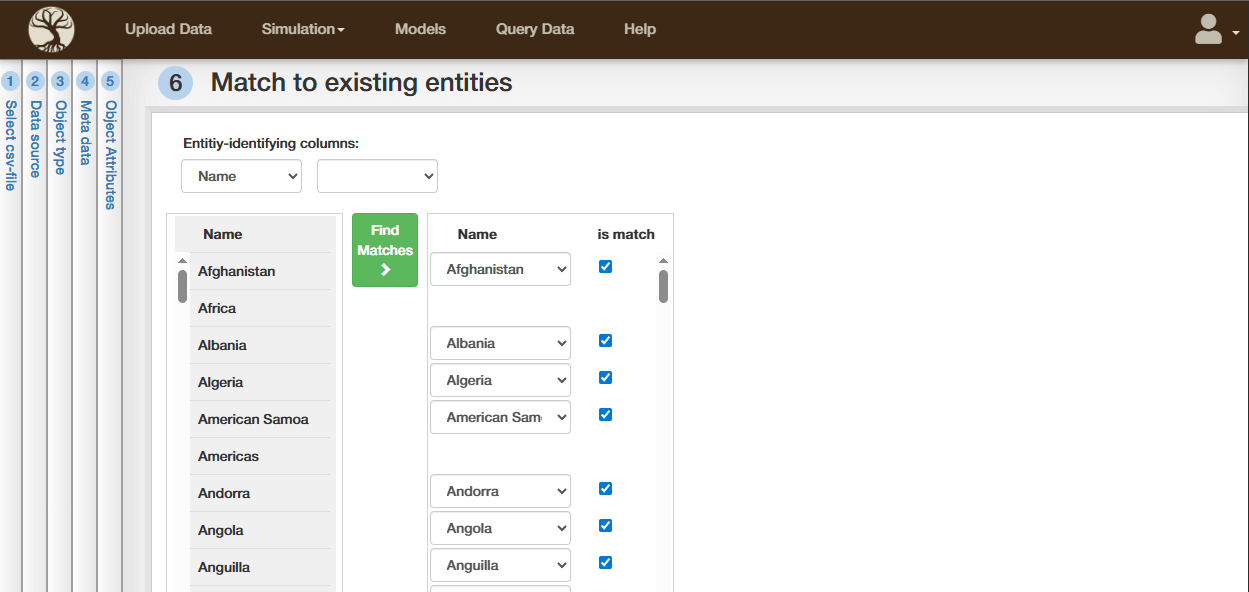
This allows the Knowledge Base to integrate, accumulate and reconcile all the country data coming from different datasets
2018
12 Nov 2018
Knowledge base created
A knowledge representation that can store data from any dataset.
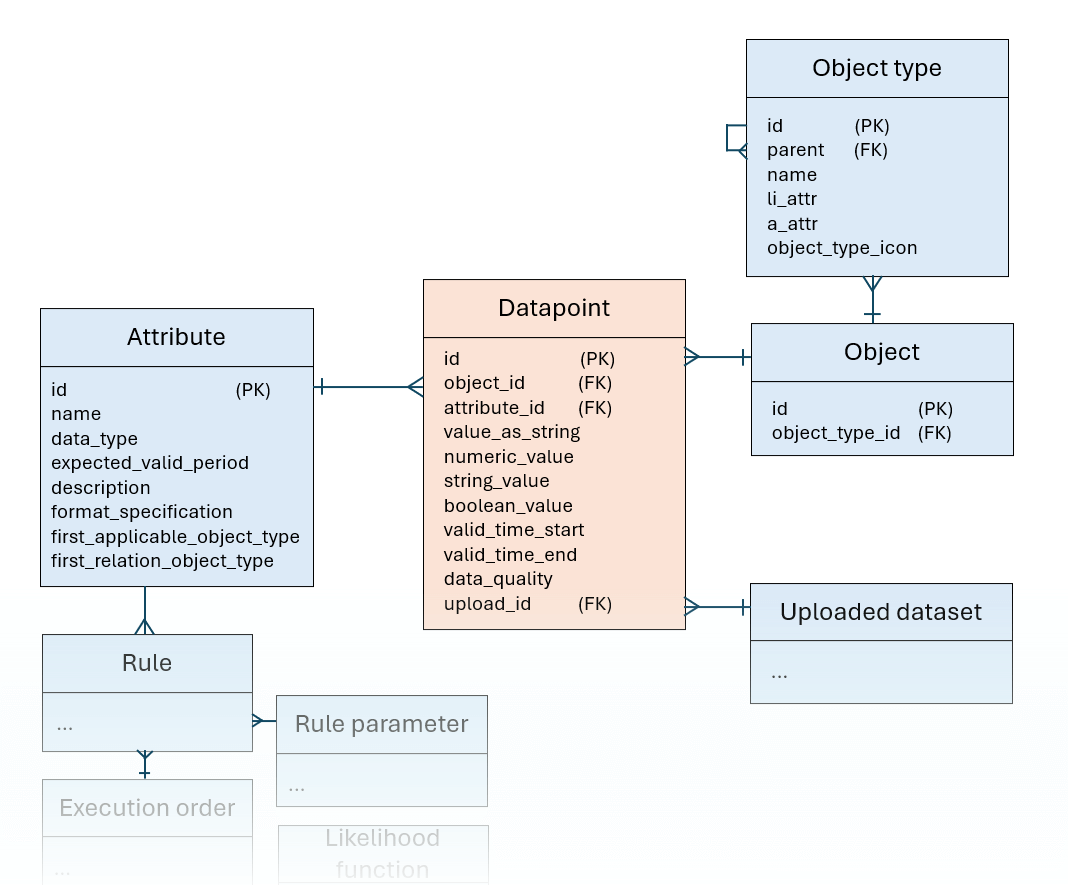
The Knowledge Base has a specific structure ("knowledge representation") that allows for any data from any dataset to be integrated and strored in this structure.
At the core of this structure are the following elements:
This data structure/knowledge representation is not only used for integrating all the data, it is also used for the simulation agents - allowing things like simulation initialisation, parameter inference and rule evaluation to be completely automated.
At the core of this structure are the following elements:
- Object & Object Type
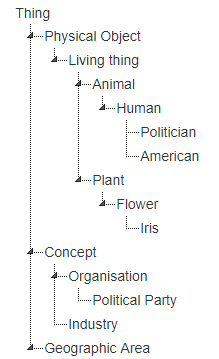
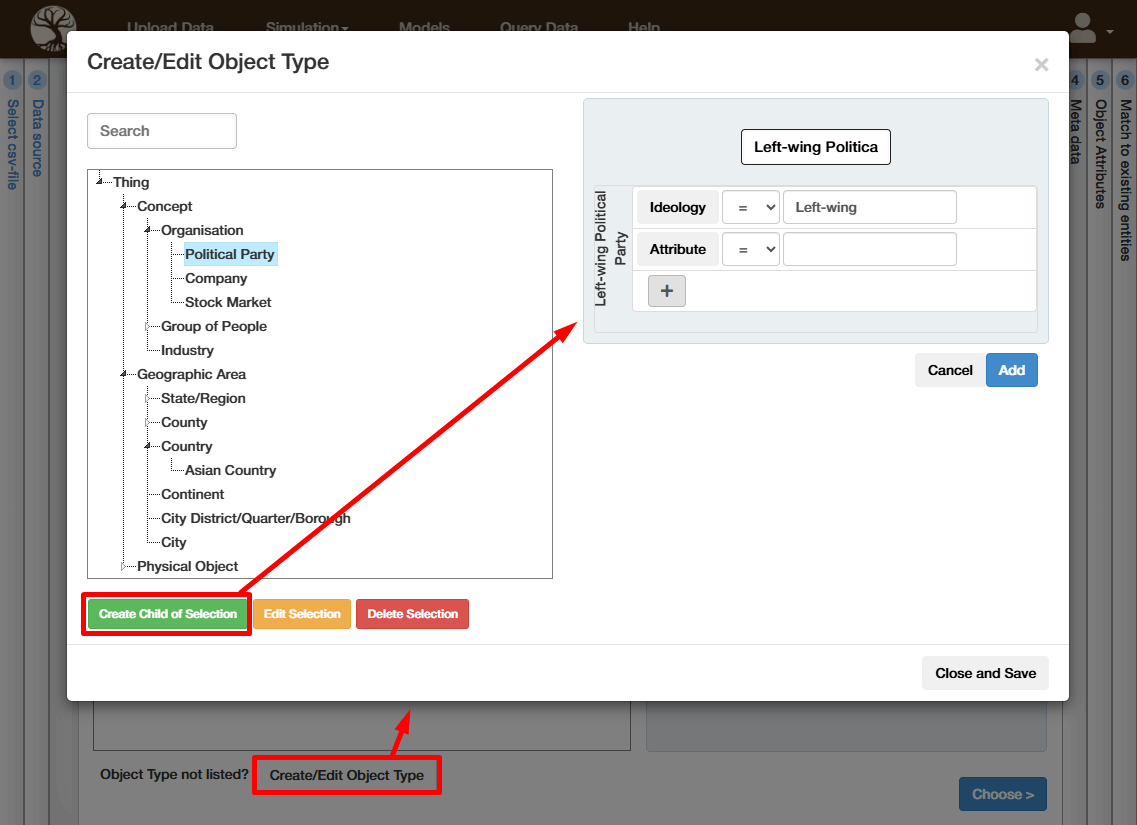
An object (e.g. Adam Smith) is an instanciation of an object type (here: human). The object type human inherits all properties from its parent object types, which are [object -> living thing -> animal -> mamal] as well as [concept -> legal entity].
The parent-child relationships of object types are captured by the Object Hierachy Tree - see image below. - Attribute
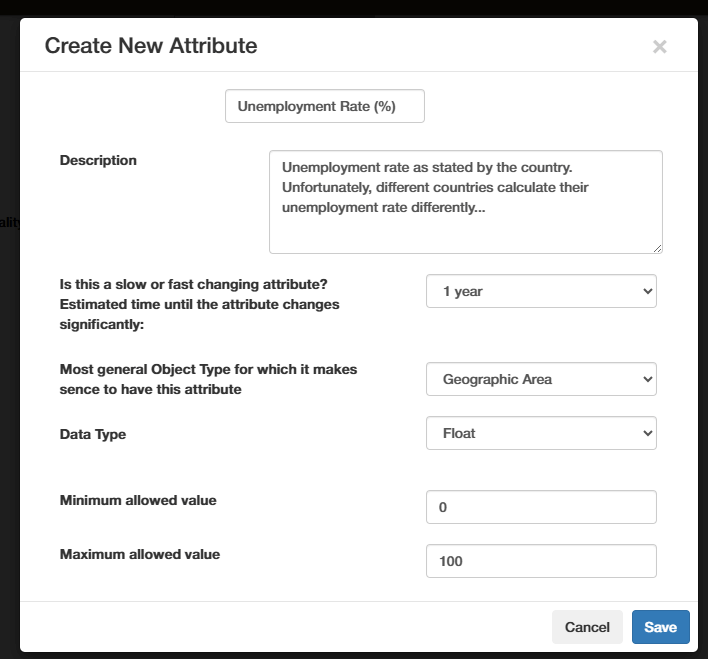
Objects of a certain type (e.g. human) have attributes (e.g. height, age, weight,...) which specify details about this object. - Datapoint
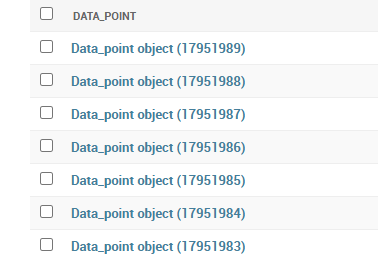
A datapoint usually corresponds to a single cell in a data table. Each datapoint describes the value of an object's attribute at a specific point in time.
Any dataset (crosssectional, timeseries, panel data) can be split up into these datapoints
This data structure/knowledge representation is not only used for integrating all the data, it is also used for the simulation agents - allowing things like simulation initialisation, parameter inference and rule evaluation to be completely automated.
It is not possible to forsee the types of objects and behaviors that researchers will want to study. Tree of Knowledge is therefore fully extensible...
3 Oct 2018
Basic Webservice
A Django webservice with user accounts, the first pages and the treeofknowledge.ai domain.
This involved: hosting a django webservice on Heroku; making the home-, about- , news-, contact-pages; setting up user accounts with salted-hash password encryption; registering and setting up the domain treeofknowledge.ai