Building a morecumulative science.
Tree of Knowledge brings together data, models, and people to build a shared, connected understanding of the world.
We believe in the power of cumulative knowledge.
Our mission is to accelerate progress in economics and the social sciences by creating an open platform where research can be connected, replicated, and extended. We combine statistical analyses, datasets, and computational models into a single, growing knowledge base — helping researchers build on each other’s work to answer bigger questions.
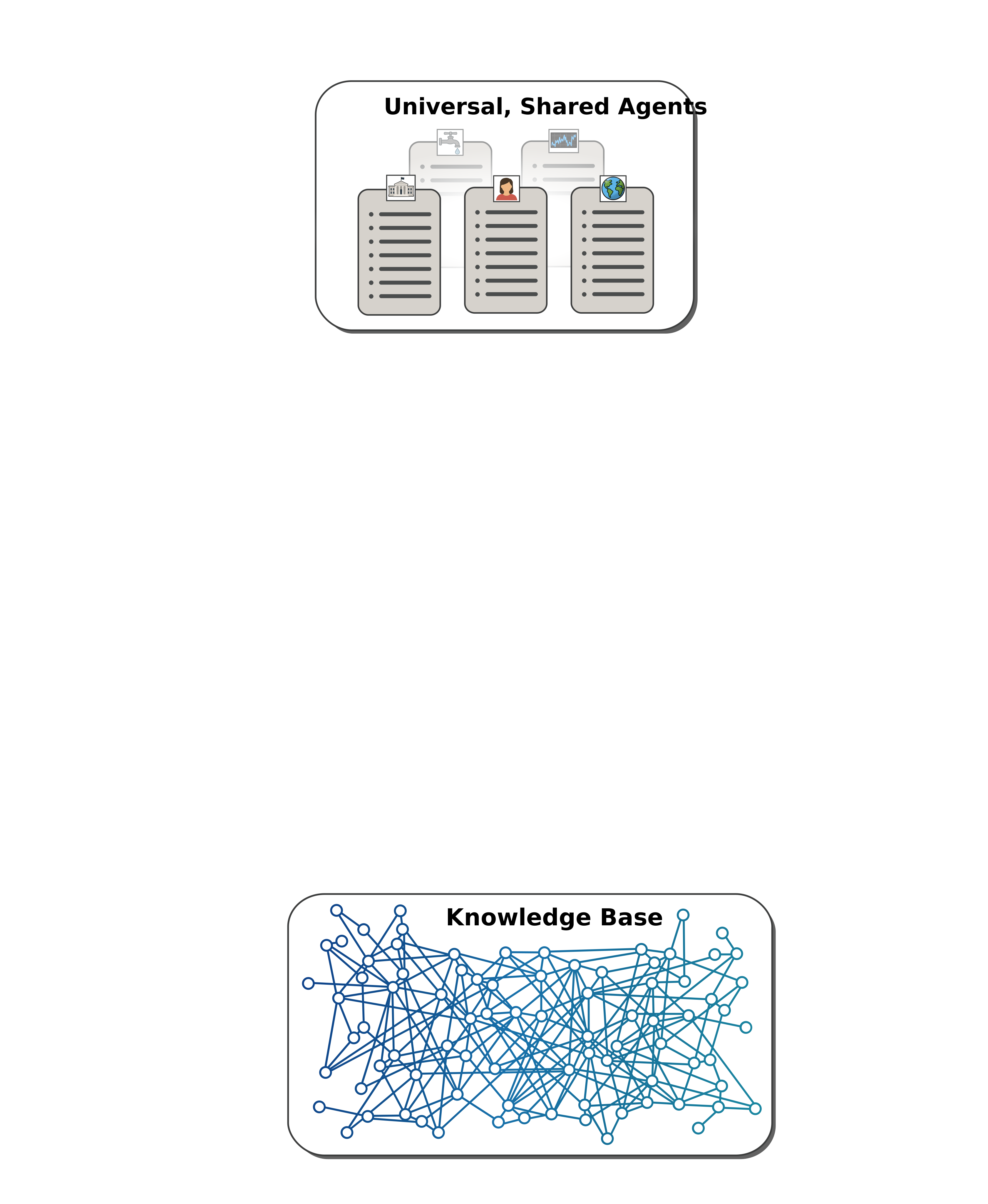
Knowledge Base
A unified, structured repository of datasets, variables, relationships, models, and findings from across research.
Shared Simulation Agents
Pre-built, customizable agents that researchers can use to model human behavior and economic systems.
Library of Modelled Datasets
A growing collection of datasets modelled with the shared agents. This lets researchers test new theories (=agent behavior rules) across many studies, populations, and contexts.
From individual studies to a connected whole.
Watch the video to learn how Tree of Knowledge integrates statistical analyses and datasets into a shared, cohesive structure — so each project can benefit from previous research and contribute to building a more complete and accurate model of the social world.
- Combine evidence from many studies
- Test and compare competing theories
- Build and simulate models of human behavior
- Generate new insights from collective knowledge

Watch to learn how Tree of Knowledge works
A simple workflow, from question to insight.
Whether you're exploring a new idea or testing an existing theory, Tree of Knowledge provides the tools to help you move from isolated studies to cumulative knowledge.
Explore
Find datasets, studies and models relevant to your reserach question.
Build
Use Tree of Knowledge to model your data, test theories, or simulate new systems.
Evaluate
Compare explanations, quantify uncertainty, and test results across contexts.
Contribute
Add your results back to the shared knowledge base so future research can build on them.
Three ways researchers can work with the system.
These modes help researchers understand observed systems, improve the shared theory, and explore new ones. Click on the elements below, to see how it works in detail.
Build a digital twin of the system behind your data. Tree of Knowledge fits the shared agents and their behavior to your observations, estimating which parameter values and mechanisms are consistent with what you measured. Watch the simulation unfold to explore how those mechanisms could have produced the patterns in your data.
Propose new behavior rules and test whether they improve predictive accuracy across thousands of diverse datasets. If they do, they become part of the shared model that everyone builds on.
By iteratively improving the shared model like this, we will obtain universal and highly accurate agent-models that make reliable predictions in any scenario. I.e. Fundamental Theories for the behavior of humans and other social agents.
Use the calibrated model to run forward simulations. Design new policies, institutions or environments and see how the agents would respond — before anything is built.
Frequently Asked Questions
Answers to common questions about Tree of Knowledge.
E.g. the trigger for the action “tidy the house” should not only depend on the state of the house, but also on a person's personal dirt sensitvity.
If a theory, that has been trained and optimized on hundreds of datasets, says that there is a high uncertainty attached to a specific prediction, then we can be confident that this is truly the case.
By knowing which systems are inherently uncertain and and unpredictable, we can disprove anyone who claims to know what will happen (which is not uncommon in public discourse).
Furthermore, the probabilistic predictions (due to Monte-Carlo simulations) still give us reliable probabilites for the different outcomes.
Help build a more cumulative future.
Be part of a growing community of researchers working together to better understand the social world.