Solve the Biggest Challenges in Empirical Economics
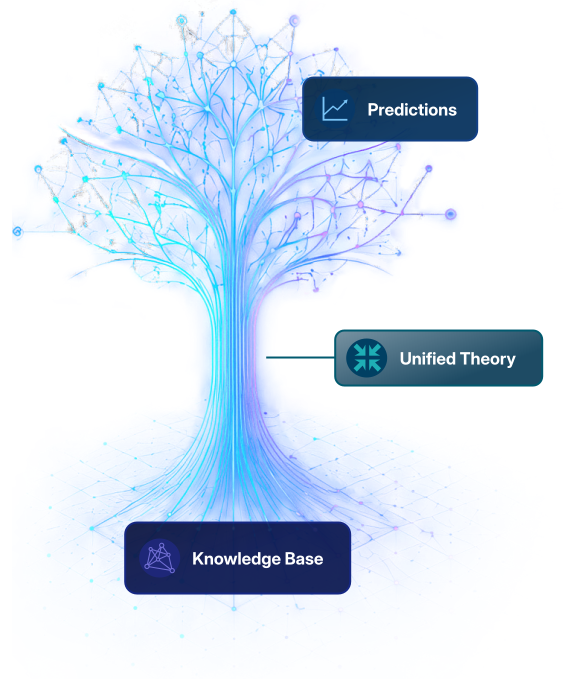
Tree of Knowledge is an online platform that merges statistical analyses and datasets into a single, connected truth.
Researchers can investigate their own questions as usual — while their work simultaneously contributes to a growing body of connected evidence and models that other research can build upon.
This makes it possible to:

Research is fragmented.
Datasets, analyses and models usually remain isolated within individual studies.
This makes knowledge difficult to accumulate and complex systems difficult to understand.
Datasets are scattered
Evidence is distributed across studies and formats.
Analyses are disconnected
Models rarely become building blocks for future research.
Knowledge is difficult to accumulate
Researchers often recreate work instead of building on it.
Complex systems remain
difficult to model
Individual studies capture only a small part of what is happening.
From isolated studies to cumulative knowledge.
Tree of Knowledge integrates statistical models and datasets into a shared, cohesive structure - so each project can benefit from previous research and contribute to increasingly accurate and comprehensive models of economic and social systems.
This allows researchers to:
- Test models across hundreds of datasets and contexts
- Build comprehensive fundamental theories
- Model complex systems accurately
Solving Statistics’ Biggest Challenges
Explore how Tree of Knowledge tackles the core challenges in empirical research - from non-aligned results to noisy data.
Watch the videos to learn more
 4:32
4:32
Progress through Organisation
Research produces valuable insights about people, countries and institutions/organizations. These insights are however disjoint, messy and sometimes even contradictory.
Learn how Tree of Knowledge not only makes sense of it all, but allows our understanding to grow far beyond what is currently possible.
 3:58
3:58
Solve the Replication Crisis
The Replication Crisis showed that a study (or set of studies) from just a single environment and setting, is not sufficient evidence for proving a universal phenomenon.
To prove a phenomenon to exist universally, you must show it to exist in many different different environments and settings. Tree of knowledge does this automatically.
 5:12
5:12
Model complex systems
Current statistics can only handle a single phenomenon at a time. That's why studies have to be designed to eliminate other effects/phenomena (and that's why using observational data is usually not possible).
With Tree of Knowledge, researchers can learn insights from noisy observational data - the many modelled effects in the shared model allows the platform to account for and filter out many of the disrupting effects.
Creating Fundamental Theories
From the laws of physics to the behavior of societies — fundamental theories let us understand complex systems, simulate them, and design a better future. Tree of Knowledge brings this possibility to the social sciences.
Fundamental theories
enable modern engineering.

Fundamental theories - such as Newtonian Mechanics or Electromagnetism - accurately describe how the individual components of physical systems behave. Because these laws apply universally, engineers can combine them to simulate entirely new and highly complex systems — from aircraft to microchips.
the same for
social systems?
Tree of Knowledge's framework allows researchers to build accurate fundamental theories of human behavior and other social actors: general, micro-level models that are continuously tested and refined for predictive accuracy across thousands of diverse, real-world datasets.
A new era of possibility.

By combining these fundamental theories, researchers can simulate entire economies and societies — producing probabilistic predictions of how complex social systems will behave.
Just as engineers can simulate new technologies before building them, social scientists could simulate new social systems before implementing them — allowing us to design better institutions, incentives and policies.
From understanding social systems
to engineering better ones.
See how it works
Further Advantages
Tree of Knowledge offers many more advantages that make research more efficient, reliable and impactful.
-
Easy to use
10 advantages -
Better statistics
7 advantages -
 New statistics
4 advantages -
Clear insights
5 advantages -
 Streamlining research
6 advantages
Powerful research, without the friction.
Advanced analysis without the technical overhead - so you can focus on the research itself.

No programming required
Data transformations are handled automatically by the Knowledge Base, and inference & evaluation are done by the Bayesian framework.

Avoid errors
The automatic data transformation, model inference and result calculation reduces the possibility of human errors in these steps.
Easy statistics
P-values are famously hard to interpret. The Bayesian framework underlying this platform however automatically produces easy-to-understand confidence intervals.

Fast
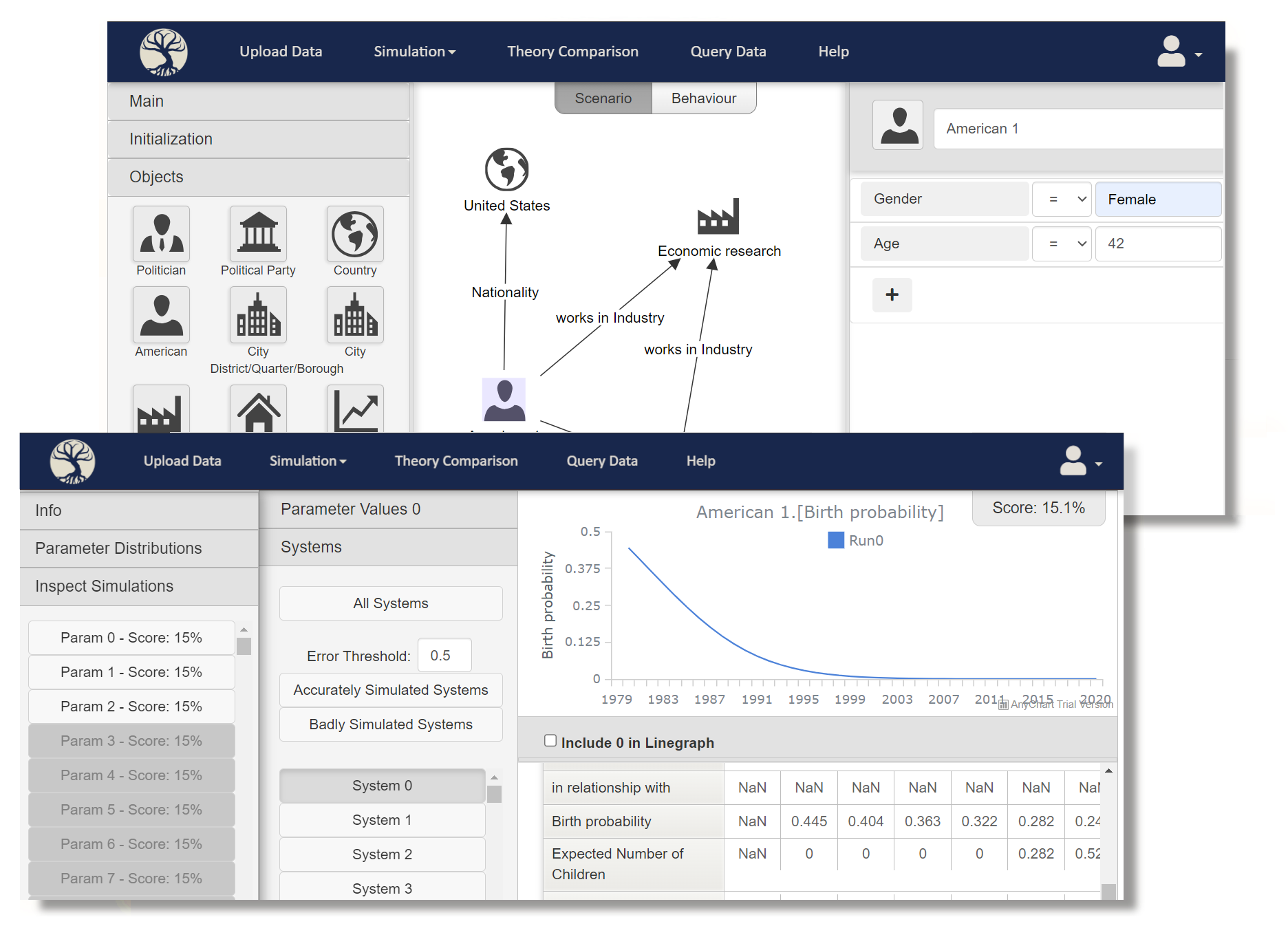
Create a model in seconds - by clicking together pre-trained agents.

Fun
Not only are the simulation models intuitive and visually appealing, working with them can also be as fun as playing an economic simulation game.

Easy predictions
With a few clicks you can bring different actors/agents into the right configuration and model the scenario you're interested in.

Easy communication of results
Due to their intuitive and visual nature, the simulation models can also be easily communicated.

Publish data with one click
Tree of Knowledge has at its core an extremely powerful knowledge base (see below) which manages all data and related meta data.
This Knowledge base not only allows the inference framework to automatically retrieve the right information. It also allows the data and meta data to be published in an extremely easily findable and retrievable manner.

Punish analyses with one click
Pubish your models and analyses with one click.

Easy Setup
As it's an online platform, it needs no installation and can be used from any device.
More evidence. More confidence.
Test models across many datasets and contexts to make results more robust, reliable and generalisable.

Universal
Due to being tested in such diverse range of scenarios, the fundamental theories are proven to be truly generalisable/universally applicable.

Accurate and Reliable
Due to being trained on such a large and diverse collection of datasets, the fundamental theories are vastly more proven, reliable and accurate.

Free from bias
Nearly every single dataset is subject to some sort of bias (e.g. selection bias, subject bias, etc.). When training on many datasets, these biases however cancel out.

Powerful model selection
“Most models fit to a single dataset, but only the truly correct model fits all datasets” – By evaluating models on hundreds of datasets, we can identify the truly correct model.

Powerful Predictions
Unlike other models, the fundamental theories allow us to accurately model and predict absolutely any social system.

Counterfactual analysis and system optimisation
With these theories we can model any social system. This allows us to investigate how well slightly modified systems would perform and ultimately, allows us to find the system configuration that works best.

Data Quality
The Knowledge Base does automatic data quality checking and validation.
Learn from data that was previously too difficult.
Account for more of the system to reduce noise, uncover hidden effects and extract insight from observational data.

Cancelling out noise
Noise in datasets comes from un-accounted-for effects in the observed system. As the theories in tree of knowledge already include many pre-trained effects, many of the previously un-accounted-for effects are now automatically included in the model, which significantly reduces the noise.

Studying hidden effects
The internal mechanisms of complex systems are often not directly observable. The pre-trained effects in tree of knowledge make it possible to strip away most the surrounding effects and thereby revealing the hidden one.

Observational datasets
The largest openly available datasets are observational datasets. Up until now most of them couldn't be used for research, because the interesting phenomena are only indirectly observed. The above-mentioned ability to extract hidden/indirectly observed effects can however help out.

Mechanistic inference
Causal inference is a growing area of interest, because the inferred casual relationships teach us more about the world than simple corporations. Tree of knowledge goes further still - with mechanistic inference we can even infer from data the exact mechanism governing a system.
Models you can actually understand.
Use meaningful rules and interpretable parameters to see what is happening inside the system.
Understandable rules
Frequentist statistics require rules/models be a generalized linear model. The Bayesian framework underlying this platform however allows any rule including non-continuous ones (e.g. with if-then conditions).

Test concrete hypotheses
Being able to specify any rule, allows us to encode and evaluate any mental model we may have.

Understandable parameters
If we encode mental models as rules, instead of blindly fitting a linear model to everything, the model parameters will have a real-world meaning and training then will teach us a lot about the world.
Detailed mechanics
By watching simulations you can understand how the individual interactions drive the dynamics of a system. It also allows you to spot important features, such as inefficiencies, bottlenecks and transitions.
Predictions with exactly understood uncertainty
When simulating a system, the uncertainty of the rules is accurately propagated through the simulation and is reflected as easy-to-understand probability distribution of simulation outcomes.
Research that builds on research.
Shared models, measures and data make collaboration easier and let every project contribute to what comes next.

Immediate adoption
If you find a better model for some phenomenon, this better model will automatically be integrated into the default theory in tree of knowledge and will be immediately used by the majority of researchers using this platform.
Standardization of measures
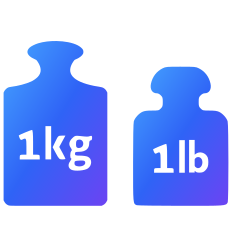
There are many ways to measure things such as ‘someone's happiness’. Tree of knowledge provides a big incentive to use the same measure as other people do, because not doing so will introduce a lot of uncertainty to your results - see "Mapping measures".

Integrating disciplines
On this platform researchers from across the human sciences (psychology, economics, political science, sociology, behavioral science etc) can collaborate to create a powerful shared theory.

Easier collaboration
Being an online platform, you can easily share your data, models and analyses in colleagues, allowing them to see what exactly you're working on or even join in.

Resolving long standing disagreements
Showing that a model performs better than another on hundreds of different datasets is the only objective way of showing that the model is indeed better. We are convinced that many long standing disagreements/schools of thought can be resolved this way.
Mapping measures
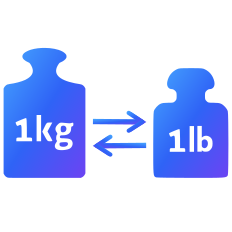
There are many ways to measure things such as ‘someone's happiness’. When researchers use different measures for the same thing, then this research can only be integrated/combined if there is a way to map from one measure to the other. Tree of Knowledge has many such mapping functions predefined.